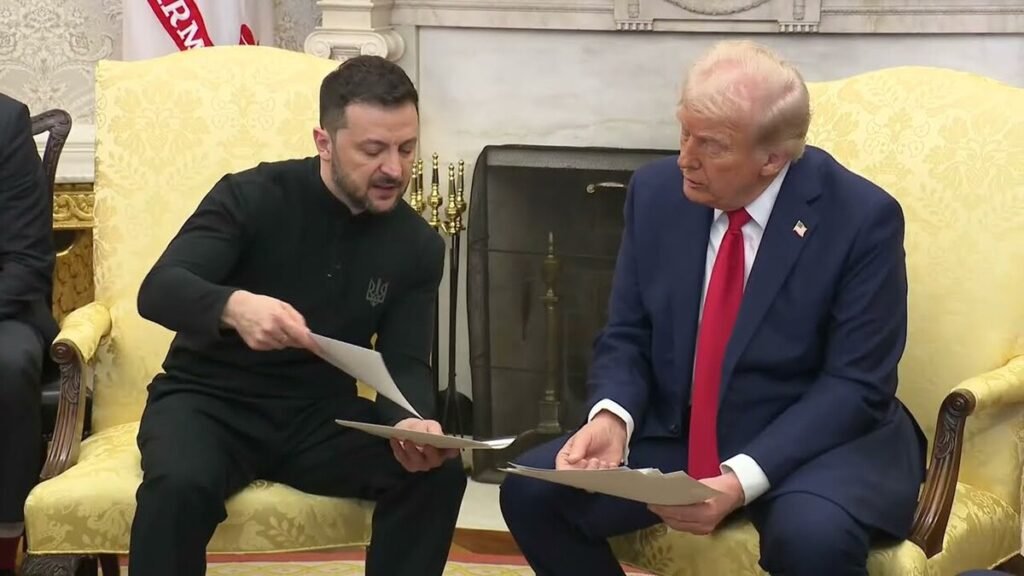
The U.S., under Donald Trump’s direction, has presented Ukraine with a sweeping 28-point peace framework in coordination with Russia, demanding major concessions by Kyiv such as territorial recognition, military caps and NATO renunciation. Ukraine now faces what its president aptly described as “an extremely difficult choice — either loss of dignity or the risk of losing a key partner.” The proposal differs from prior peace efforts in its timing, scope, and underlying power dynamic. It also opens important maritime and regional strategic repercussions.
1. Key Elements of the Proposal
According to the latest disclosures, the 28-point plan includes the following core terms:
- Ukraine would recognise, directly or de facto via U.S./Western endorsement, Russia’s control over the entire eastern Donbas region (including parts still held by Ukraine) and possibly the Crimea peninsula.
- Kherson and Zaporizhzhia oblasts would remain “frozen” along current boundaries, thereby locking in Russian advances.
- Ukraine’s military would be capped at roughly 600,000 personnel.
- Ukraine would constitutionally abandon any future membership in NATO and agree to host no foreign troops.
- In return, the U.S. guarantees security and pledges a “decisive coordinated military response” if Russia violates the agreement, along with sanctions reinstated if provoked.
- Economic provisions: phased removal of sanctions on Russia, joint U.S.–Russia investment and reconstruction in Ukraine, partial redirection of frozen Russian assets, and reintegration of Russia into institutions such as the G8.
2. What Makes This Attempt Different
(a) Timing and pressure
The plan arrives at a moment of severe strain for Ukraine: military pressure on the front, political turbulence (including corruption scandals), energy infrastructure attacks and winter approaching.
Further, the U.S. has set a very short deadline for Ukrainian acceptance—raising the stakes.
(b) Back-channel architecture & pro-Russia tilt
The plan was developed via informal channels: U.S. Special Envoy Steve Witkoff and Russian economic negotiator Kirill Dmitriev played major roles. Ukrainian critics argue Ukraine was marginalised in formulation.
Experts caution the proposal resembles a Faustian bargain for Kyiv: heavy concessions, uncertain guarantees.
3. Geopolitical & Defence Implications
- The plan effectively pivots U.S. policy toward rapid conflict resolution—even at the cost of Ukrainian red-lines. This signals a shift in U.S. strategic patience and risk appetite.
- Russia’s endorsement of the proposal (via Putin calling it a “modernised” version of previous frameworks) gives Moscow diplomatic leverage and legitimises many of its gains.
- Europe is marginalised in the drafting, causing strains: EU and NATO partners urge inclusion of Ukraine and reject key concessions as weakening the alliance.
- For Ukraine, the choice is domestic (political legitimacy and national dignity) and external (military support, relationships with allies). Zelensky has framed the decision as existential.
4. Maritime & Regional Strategic Dimensions
(a) Maritime access & littoral security
Though the immediate framework concerns land and sovereignty, the maritime domain is indirectly affected:
- Territorial/code recognition of regions such as Crimea (which controls the Black Sea littoral) and Donbas opens questions about maritime claims, naval basing and control of straits.
- Freezing of military deployments under the deal may decrease Ukrainian naval/deterrence capacity in the Black Sea and Sea of Azov region—potentially altering the maritime force balance.
(b) Energy, infrastructure & shipping
- The plan includes large infrastructure and reconstruction investments; many of these will involve maritime logistics (ports, shipyards, cables). U.S.–Russia investment cooperation may prompt Russian naval access or dual-use infrastructure in littoral zones.
- Shipping through the Black Sea, access to Ukrainian ports (e.g., Odesa, Mariupol) and transit corridors could become subject to new security arrangements or frozen status, increasing risk for commercial shipping and insurance premiums.
(c) Regional spillovers
- Turkey, as a Black Sea and Aegean stakeholder, must monitor whether the plan affects Turkish Straits access, Black Sea naval posture or Sea of Marmara transit rules.
- NATO’s southern flank (Romania, Bulgaria) will observe whether blocking Ukraine’s membership under the plan affects alliance deterrence vis-à-vis Russia’s maritime posture in the Black Sea.
- Energy routes (e.g., pipelines, LNG) connecting Ukraine, Russia and Europe often involve port infrastructure and maritime shipping — any reconstruction regime or Russian reintegration could reshape those flows.
5. Strategic Risks & Next Steps
Risks
- The guarantees given to Ukraine are vague; history suggests Russia may not abide by legal commitments and Ukraine will be left exposed.
- Domestic backlash in Ukraine is likely: territorial concessions are politically toxic, and any sense of forced capitulation may destabilise Kyiv’s government.
- European allies may feel side-lined, potentially weakening transatlantic cohesion at a critical juncture.
- Russia could use the process to legitimise its gains while planning future revisionism under cover of diplomacy.
Next Steps
- Kyiv must decide whether to engage substantively with the U.S. proposal, propose counter-terms, or reject it. Zelensky has signalled willingness to talk but not to capitulate.
- European states (Germany, France, UK) are deepening consultations with Ukraine on their own counter-proposal.
- Monitoring how the U.S. enforces its deadline, what incentives or threats accompany it, and how Russia reacts will determine whether this becomes a genuine settlement framework or a façade.
6. Implications for Defence Room Audiences
- Navies, maritime logistics operators and port authorities should reassess risk in the Black Sea and Sea of Azov – especially regarding new maritime access rules, basing changes and naval redeployments.
- Defence planners in NATO and regional littoral states must incorporate this deal’s potential effects on force posture, alliance enlargement prospects and deterrence credibility.
- Trade and infrastructure strategists should watch for new U.S.–Russia–Ukraine investment vehicles, reconstruction contracts covering ports and shipping, and how frozen Russian assets may flow into maritime-adjacent industries.
Conclusion
The 28-point U.S. proposal is not simply another peace plan; it is a strategic gambit with profound implications for Ukraine’s sovereignty, European security architecture, and the maritime dynamics of the Black Sea region. Ukraine stands at a diplomatic crossroads, and the ways in which it navigates this moment will shape the Defence Room’s maritime and geopolitical environment for years to come. The maritime domain, often overlooked in land-centric negotiations, remains a critical theatre of power.