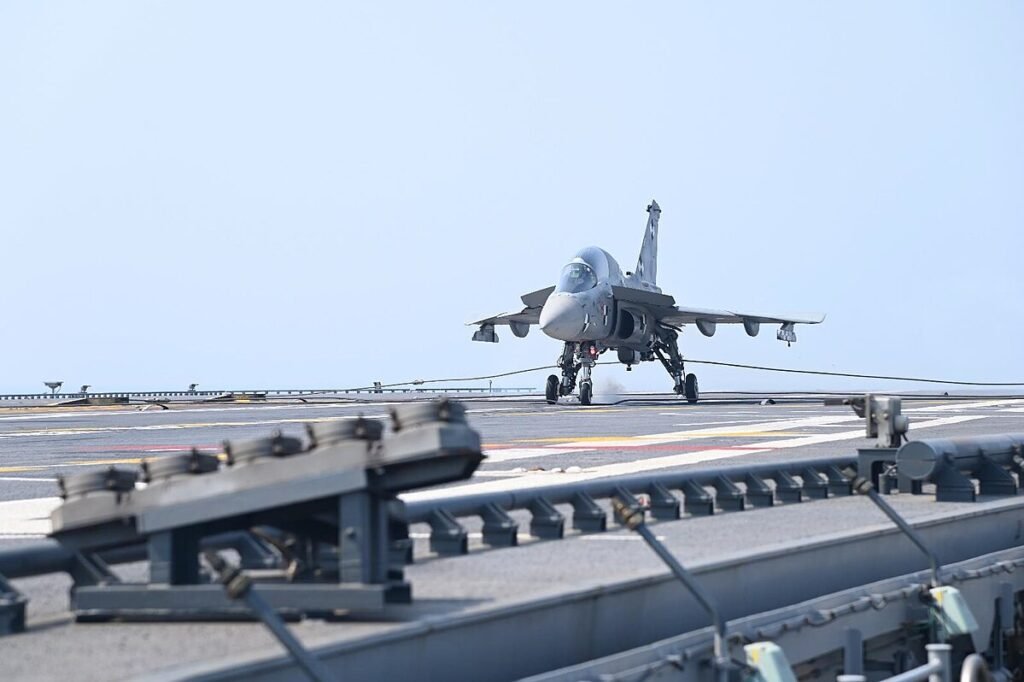
DUBAI, November 21, 2025 – A festive atmosphere at the Dubai Air Show turned into a scene of shock and mourning on Friday afternoon when an Indian Air Force (IAF) Tejas Mk1 fighter jet crashed during an aerial display, killing the pilot, Wing Commander Namansh Syal. The incident, which occurred at approximately 14:10 local time at Al Maktoum International Airport (DWC), marks the first fatal accident in the history of India’s indigenous Light Combat Aircraft (LCA) program.
The Crash: “A Ball of Fire”
The crash took place during the final maneuvers of the aircraft’s solo display. According to eyewitnesses and video footage analyzed by defense experts, the aircraft was executing a complex negative-G maneuver or a “low roll” when it abruptly lost altitude.
“The aircraft had been flying for about eight or nine minutes,” said Jignesh Variya, a spectator at the show. “It went into a nose-dive… I could see three different fireballs when it collided with the ground.”
Footage shared on social media showed the single-engine delta-wing fighter diving steeply toward the ground within the airfield perimeter. Unlike a previous incident in Jaisalmer in 2024, where the pilot ejected safely, there was no sign of an ejection attempt in Dubai. Aviation experts suggest the low altitude—estimated to be below 500 feet—and the high rate of descent likely placed the aircraft outside the safe ejection envelope.
The Pilot: A Veteran Indian Air Force Aviator
The Indian Air Force identified the deceased pilot as Wing Commander Namansh Syal, 37, a native of the Kangra district in Himachal Pradesh. Wing Commander Syal was a decorated aviator known for his precision flying. An alumnus of the National Defence Academy (NDA), he had previously won the ‘best in aerobatics’ award during his training. He was serving with one of the IAF’s frontline Tejas squadrons, likely the “Flying Daggers” or “Flying Bullets,” and had extensive experience flying both the MiG-21 and the Su-30MKI.
Defense Minister Rajnath Singh expressed his anguish, calling Wg Cdr Syal “brave and courageous,” while the IAF stated it “stands firmly with the bereaved family in this time of grief.”
The “Oil Leak” Controversy: Fact vs. Rumor
The tragedy was preceded by a storm of misinformation. On the day prior to the crash, videos circulated on social media claiming the Tejas was leaking oil on the tarmac. The Government of India’s Press Information Bureau (PIB) swiftly debunked these claims before the accident occurred, clarifying that the fluid was condensed water draining from the Environmental Control System (ECS) and On-Board Oxygen Generating System (OBOGS)—a standard occurrence in Dubai’s humid climate.
While the “oil leak” was ruled out as a hoax, the timing of the crash has allowed speculation to persist online. A Court of Inquiry has been constituted to determine the actual cause, investigating factors ranging from mechanical failure (such as the engine seizure seen in the 2024 Jaisalmer crash) to G-induced Loss of Consciousness (G-LOC).
Strategic Impact: A Blow to Export Ambitions?
The crash comes at a critical moment for Hindustan Aeronautics Limited (HAL), which is aggressively pitching the Tejas to nations like Argentina, the Philippines, Egypt, and Nigeria.
- Export Jitters: Analysts fear the “Ecuador Precedent”—where a series of crashes led Ecuador to ground its fleet of Indian-made Dhruv helicopters—could haunt the Tejas program. A fatal crash during a sales pitch is the worst-case scenario for building confidence with potential buyers.
- Market Reaction: Despite the tragedy, HAL’s stock price remained relatively resilient, closing down just over 1% on Indian exchanges. Market analysts believe the company’s massive domestic order book provides a safety net against short-term volatility.