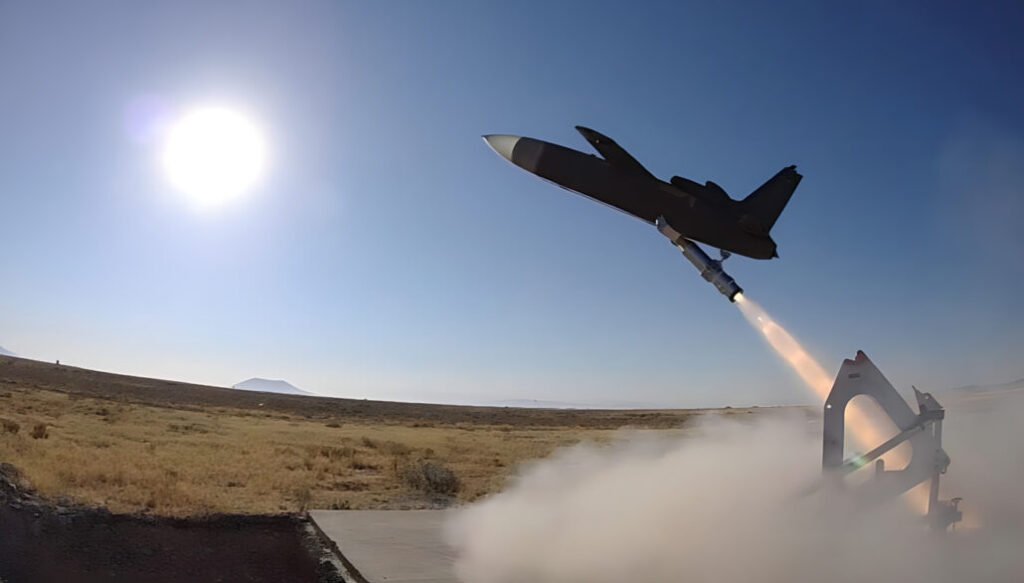
ANKARA — The existence of a new jet-powered loitering munition program named AYAZ, reportedly developed by Turkish Aerospace Industries (TAI), has been corroborated by a name registration found in the Turkish Patent and Trademark Office (TÜRKPATENT) records. The program is being developed as a purpose-built, single-use attack system optimized for loitering-munition (LM) missions, distinct from TAI’s earlier multi-role platforms.
Unlike the ŞİMŞEK family — which were designed as target aircraft and multi-purpose platforms — AYAZ is being conceived without secondary recovery equipment, enabling a lighter, single-use architecture and driving expectations that its technical performance will exceed that of its predecessors. Projections indicate AYAZ will aim for high subsonic/transonic speeds (Mach 0.90 and above) and extended ranges in excess of 900 km. Achieving those terminal-phase performance targets points toward the need for a small, high-bypass micro-turbojet or potentially a hybrid propulsion solution rather than pulse-jet or piston engines.
Design priorities emphasize penetration and terminal-strike effectiveness. AYAZ is therefore expected to feature a larger warhead capacity, a more aerodynamic and low-radar-cross-section (RCS) stealth-oriented airframe — attributes considered critical for defeating modern layered air-defense systems.
While swarm technologies supported by artificial intelligence have been present in TAI’s earlier platforms, AYAZ is anticipated to incorporate advanced AI / network-centric battle management capabilities. This would enable swarms to do more than follow preprogrammed routes: they would dynamically reassign missions in response to real-time threat detection, sensor inputs, integrated EHS data, and battle damage assessment (BDA). Planned tactics include synchronized swarm behaviours such as using sacrificial units as decoys (possibly employing legacy RCS-enhancing devices), assigning others to SEAD/DEAD tasks, and committing final waves for kinetic strikes.
Loitering munitions — also called kamikaze drones or suicide UAVs — perform a different role to conventional unmanned aircraft: they loiter over a target area until a target is detected, then impact the target with their onboard warhead, destroying themselves in the process. First developed in the 1980s for suppression of enemy air defenses (SEAD), these systems have become a flexible strike asset that can engage fleeting, concealed targets without risking high-value manned platforms.
Recent conflicts have transformed the battlefield role of loitering munitions. Cost-effective systems such as Iran’s Shahed-136 (used by Russia as the Geran-2) — operating at relatively low cruise speeds but with long ranges and low unit costs (estimated roughly $10,000–$30,000) — have been launched in swarms to strike strategic fixed targets. Likewise, Ukraine’s UJ-26 Skyline (Bober) has reportedly been used for deep-strike missions with ranges of 800–1,000 km carrying ~20 kg warheads. These examples underline the dual advantages of loitering munitions: low unit cost and the ability to overwhelm defenses by numbers.
Global demand for loitering munitions is rising and supported by market research showing significant market size and strong projected compound annual growth rates (CAGR) for the segment. TAI’s commercial pathway for AYAZ is expected to begin with extensive domestic testing and validation; subsequently, the company could pursue rapid market entry via government-to-government (G2G) channels, competitively priced modular variants, licensed production, and comprehensive service packages (training and logistics) targeted at key regions and existing customers.
Neither TAI nor the defence industry’s public spokespeople have issued formal technical disclosures or export strategies for the AYAZ program. The relevant officials say program developments will be announced as TÜRKPATENT records, testing, and certification milestones progress.