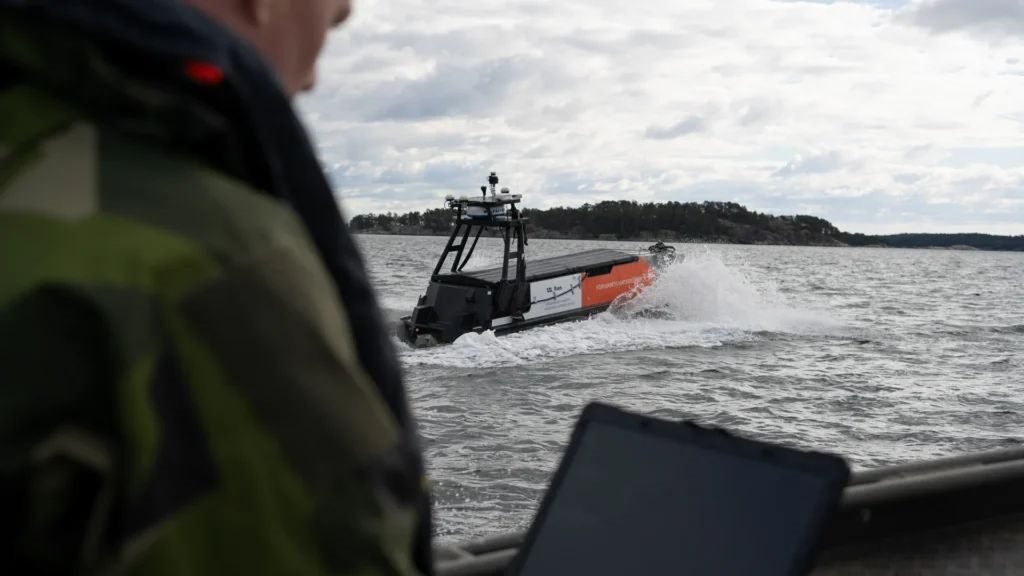
Recently, the Swedish Defence Materiel Administration (FMV) conducted trial tests with an unmanned surface vehicle (USV) in Hårsfjärden, off Berga. The tests focused on software performance, range, maneuverability, and emergency stop functions.
Johanna Norén from FMV stated, “We have acquired a small concept demonstrator vessel to conduct various tests. Our aim is to understand how it operates, how it behaves, and what potential applications it may have.”
The project is part of a three-year research and technology development program commissioned by the Swedish Armed Forces through FMV. Its purpose is to build knowledge and understanding of unmanned maritime platforms.
Robert Sandgren from FMV added, “For example, in the conflict in Ukraine, USVs play a significant role in the Black Sea. This project aims to help the Armed Forces understand what can be done with USVs, what options are available, and which requirements can be established. For FMV, the focus is on acquisition procedures, potential acceleration, and market availability.”
The project also conducts market and regulatory analyses to determine which technologies could benefit unmanned surface systems within the Armed Forces. Agnes Moberg, FMV project manager, explained, “These activities provide crucial insights into the capabilities and limitations we may encounter in future acquisitions and operational use.”
The USV used in the tests is a Norwegian model, also utilized by the Norwegian Home Guard and the navies of Spain, Denmark, and Portugal. The system features a general design capable of simulating various types of vessels. Sensors can be added to map the seabed or evaluate operational functionality for different missions.
The vessel is equipped with cameras in all directions and a LiDAR system providing precise 3D environmental mapping for safe navigation. It can be manually controlled remotely or follow pre-programmed routes and has collision detection and avoidance capabilities.
During the trials, the vessel named Ran was deployed under the supervision of a mother ship and underwent various maneuver tests. Sandgren noted, “Although weather conditions were not ideal, we conducted wave generation tests to assess maneuverability, which proved challenging in previous trials.”
Over the remaining year, the project will conduct additional tests with the unmanned vessel and continue building knowledge on acquisition and operational use of such systems. Moberg stated, “These and future trials will help answer questions regarding how the Armed Forces can and should employ unmanned systems.”
USV “Ran” Specifications
- Length: 6 meters
- Weight: 2 tons
- Maximum speed: 24 knots
- Range: 100–150 nautical miles on a single tank