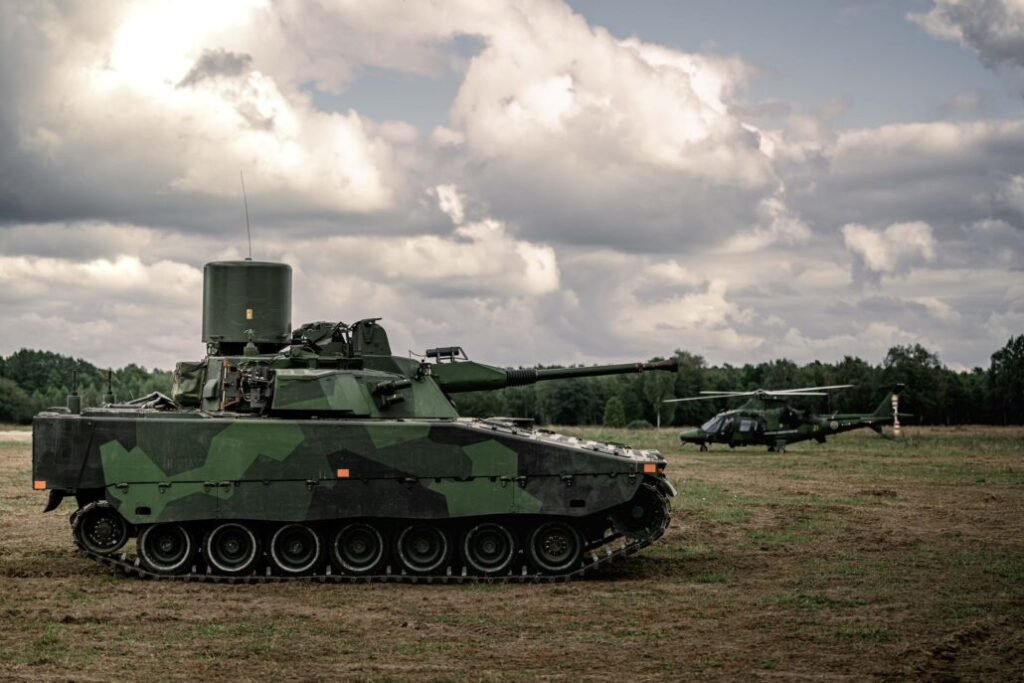
Stockholm/Riga – Sweden, a new NATO member, has decisively abandoned its long-standing military neutrality by deciding to deploy its self-propelled anti-aircraft system, the Luftvärnskanonvagn 9040 (Lvkv 9040), to the Canada-led NATO battalion in Latvia. Scheduled to arrive in early 2026, these systems mark Sweden’s first overseas artillery-based air defense deployment since the Congo Crisis in the 1960s, representing a historic milestone.
Cost-Effective Counter-Drone Solution
The Lvkv 9040 is a dedicated air defense variant built on the widely used Combat Vehicle 90 (CV90) chassis. Capable of a maximum speed of 70 km/h, it can maneuver alongside NATO’s mechanized forces. At its core is a 40 mm Bofors L/70 gun developed by BAE Systems/Bofors, equipped with programmable proximity-fuzed ammunition (3P) to maximize effectiveness against aerial threats. The turret-mounted PS-95 surveillance radar provides 360-degree situational awareness at the battalion level.
Experts highlight Lvkv 9040’s critical advantage as a cost-effective solution against low-cost UAV swarms. Its programmable ammunition negates the need for expensive missile systems and can engage a wide range of targets, including helicopters, light armored vehicles, and low-altitude cruise missiles. Colonel Tobias Christensson, Commander of the South Skåne Regiment’s 71st Battalion, emphasized that the deployment enhances detection and engagement of airborne threats like drones and helicopters at the battalion level.
Integration into Baltic Air Defense Architecture
Sweden’s contribution adds a vital mobile armored layer to Latvia’s multi-tiered air defense network. Mid-range coverage is provided by Spain-deployed NASAMS and upcoming deliveries of German IRIS-T SLM systems in 2026. Short-range defense includes RBS 70 NG systems supplied under a SEK 2.1 billion (approx. USD 200 million) framework agreement with Swedish manufacturer Saab, capable of engaging drones, helicopters, and low-flying combat aircraft. Positioned in the center of this architecture, the Lvkv 9040 provides mobile point defense for high-value NATO command centers and logistics hubs.
Historical and Strategic Significance
This deployment represents Sweden’s first operational-level contribution to collective defense following its full NATO accession in March 2024. Sweden has already sent a reduced battalion of up to 600 personnel to Latvia’s Canada-led Forward Land Forces (FLF) brigade, transferred to NATO command in February 2025. Prime Minister Ulf Kristersson described the contribution as evidence of Sweden’s transition from a previously “slightly idealistic observer” to a “realist at the center of events,” adding that in the face of growing hybrid threats, the country remains “not at war, but not at peace,” emphasizing the maxim: “Those who desire peace must be prepared for war.”
The deployment of Lvkv 90s sends a clear geopolitical signal, reinforcing NATO’s strategic posture in the Baltic Sea region. It also demonstrates planners’ prioritization of rapidly deploying proven artillery systems against current threats, reflecting lessons learned from the conflict in Ukraine.