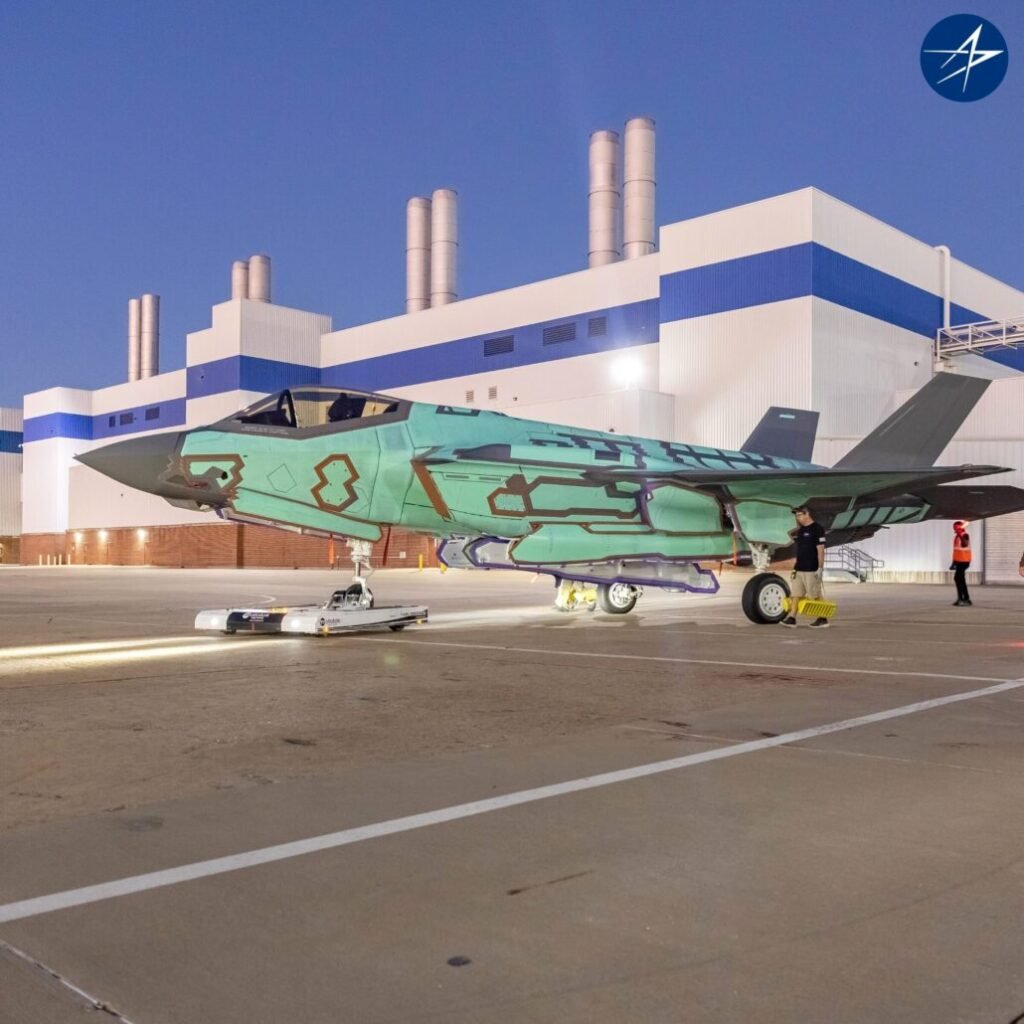
Fort Worth, Texas – U.S.-based aerospace giant Lockheed Martin announced the successful emergence of the first F-35A Lightning II fighter jet built for Finland from the factory’s final assembly line. According to the announcement made on the company’s social media accounts on Wednesday, October 29, 2025, the aircraft, designated factory number “MF-1” (serial number JF-501), departed the Final Assembly and Check Out (FACO) facility in Fort Worth, Texas, and was moved to the paint shop.
This development marks the tangible first step in fulfilling Finland’s order of 64 F-35As under the HX Program, selected in December 2021 to replace its aging F/A-18 C/D Hornet fleet. The aircraft’s emergence from the FACO line confirms the completion of complex structural processes, including the joining of the fuselage, wings, and tail sections using the Electronic Mate and Alignment System (EMAS), which utilizes lasers and sensors.
The Technological Foundation of Strategic Transformation: Block 4
Finland’s aircraft are being produced in the Technology Refresh 3 (TR-3) standard, which is set to enable the advanced Block 4 capabilities [Query]. TR-3 is not a capability in itself, but rather the essential hardware architecture that provides the F-35 with foundational hardware enhancements necessary to host complex mission software, including a new integrated core processor with greater computing power and an open mission systems architecture. Lt. Gen. Michael Schmidt, the F-35 Program Executive Officer, noted that TR-3 brings “significantly more computing power and memory than the legacy infrastructure,” likening it to a “new mobile cell phone or personal computer.”
The Block 4 modernization package encompasses over 75 major upgrades, including increased missile capacity, advanced electronic warfare (EW) capabilities, and improved target recognition. These capabilities are critically important for Finland’s ability to survive and operate in the complex contested environments of the Baltic and Arctic regions.
Delivery Schedule and Training Base
The initial Finnish F-35As will not be immediately deployed to Finland. Instead, the first eight aircraft, bearing tail numbers JF-501 through JF-508, will be delivered to Ebbing Air National Guard Base (ANGB) in Fort Smith, Arkansas, under the Foreign Military Sales (FMS) training program.
This base will serve as the FMS training hub where Finnish Air Force pilots and key sustainment crew will receive their conversion training. Personnel training is already underway in the U.S. This cadre of experts will return home in 2026 to establish the national training system and further train national personnel. The arrival of the first F-35s in Finland, at the Lapland Air Wing, is slated for 2026.
Finland targets achieving Initial Operational Capability (IOC) with the F-35 system by the end of 2027, and Full Operational Capability (FOC) by the end of 2030, coinciding with the complete retirement of the F/A-18 fleet.
Critical Role for NATO and Regional Deterrence
The procurement of 64 F-35s signals a major shift in Finland’s security priorities, guaranteeing a “high degree of interoperability” with NATO states. Following Finland’s 2022 NATO accession, the F-35 fleet will fundamentally reinforce the Alliance’s defense and deterrence posture in the Baltic Sea and the High North.
The F-35’s superior stealth, sensor fusion, and data-sharing capabilities enable it to function not just as a fighter aircraft, but also as a Command and Control (C2) and Intelligence, Surveillance, and Reconnaissance (ISR) node that can seamlessly share targeting data with allies. This capability bolsters the strategic balance in the region during a period of heightened Russian military activity. The December 2021 procurement decision was previously described by Russian media as an “unfriendly action towards Russia.”
Managing Global Programmatic Risks
While the MF-1 rollout is a significant hardware achievement, the F-35 program globally faces substantial challenges concerning Block 4 modernization schedule slips. Technical setbacks within the TR-3 hardware and software suite have been the primary cause of late aircraft deliveries globally. According to Government Accountability Office (GAO) reports, Block 4 costs have ballooned by over $6 billion, with the full capability delivery timeline potentially sliding into the mid-2030s.
These delays complicate Finland’s 2030 FOC objective. The Finnish Air Force may be required to field its fleet with only partial Block 4 capabilities in the initial years, pending the full maturity of the required software. Nevertheless, Finland’s industrial cooperation agreements, which leverage its expertise in electromagnetic and software technology , hold the potential to offer domestic solutions to mitigate potential sustainment and integration delays.
In conclusion, the emergence of the MF-1 airframe is a concrete step in Finland’s transition to a 5th-generation force structure. Despite global technical risks, the F-35 system’s qualitative advantages—stealth, sensor fusion, and networked warfare capacity—remain a strategic necessity for securing Finland’s extensive border with Russia and reinforcing NATO deterrence across Northern Europe.