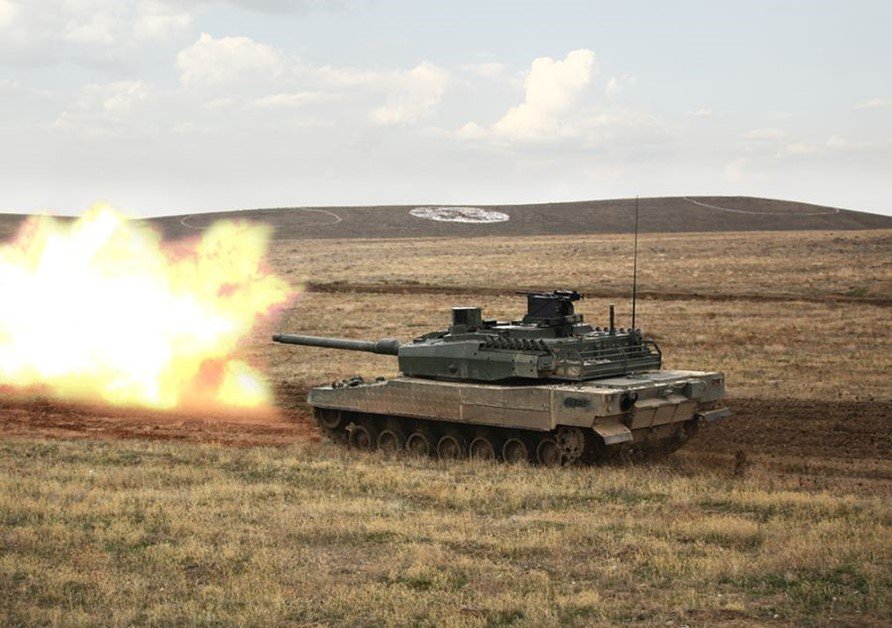
After nearly two decades of development, the Turkish Land Forces have officially received the first units of the Altay main battle tank (MBT), marking a significant milestone in Türkiye’s armored warfare modernization effort. Beyond representing the country’s long-standing ambition for defense industrial self-reliance, the delivery of the Altay T1 variant underscores a shift toward a new generation of networked, survivable, and modular land combat platforms.
After a Lengthy Delay
The Altay program, initiated in 2007 under Otokar’s leadership, faced more than a decade of setbacks, primarily due to foreign export restrictions on critical subsystems—especially the engine and transmission. These delays reinforced the strategic necessity of indigenization within Türkiye’s defense sector. The first delivery on 28 October 2025 by BMC Savunma therefore carries symbolic and practical weight: it signifies both a technological recovery from embargo-induced stagnation and the entry of the first modern tank into the Turkish Land Forces inventory in half a century.
While the initial batch of Altay T1 tanks uses a South Korean powerpack as a temporary measure, the decision to field them before the domestic BATU engine becomes operational enables the army to conduct early operational evaluation. This approach allows for field testing of locally developed systems—fire control, armor, electronics, and command networks—while tactical doctrines and crew training are refined in parallel.
Bridging the Capability Gap in the Armored Fleet
Türkiye’s current armored fleet remains dominated by Leopard 2A4s, upgraded M60TMs, and legacy M48/M60 Patton tanks—platforms whose protection levels and sensor architectures reflect Cold War-era requirements. The Altay program directly addresses this gap, delivering a purpose-built system designed to meet 21st-century battlefield realities: multi-spectrum threats, urban warfare, and network-centric operations. Unlike incremental upgrades on older hulls, Altay’s design integrates survivability, situational awareness, and digital command systems from inception.
Firepower and Combat Systems Integration
At the core of Altay’s lethality is its NATO-standard 120 mm L55 smoothbore gun, capable of firing a full range of STANAG 4385-compliant ammunition, including laser-guided projectiles. The tank’s Volkan II fire control system provides a true “hunter-killer” capability through independent stabilized sights for both commander and gunner, as well as automatic target tracking. This ensures high first-round hit probability—a decisive factor in outgunning modern anti-tank threats.
Secondary armament includes a coaxial 7.62 mm machine gun and a remotely operated weapon station (RCWS) for a 12.7 mm heavy machine gun or a 40 mm grenade launcher, enabling flexible engagement of infantry and light vehicles without exposing the crew. Together, these systems offer Altay a high degree of adaptability across urban and open-terrain scenarios.
Protection, Survivability, and Modular Armor Design
Altay’s protection suite combines locally developed composite armor, explosive reactive armor (ERA), and cage armor modules—allowing rapid adaptation against evolving threats. The inclusion of ASELSAN’s AKKOR active protection system marks a significant step toward layered defense, intercepting incoming anti-tank missiles and rockets before impact. Passive features such as mine protection kits, spall liners, and chemical-biological (KBRN) detection and filtration systems further enhance crew survivability.
Drawing on Türkiye’s operational experience in asymmetric warfare, the platform has been engineered to withstand high levels of improvised explosive device (IED) and mine threats, a persistent hazard in regional conflicts.
Mobility and Interim Power Solutions
The T1 variant employs a 1,500 hp diesel engine and automatic transmission imported from South Korea. While the use of foreign propulsion reflects a short-term compromise, it also prevents program bottlenecks, allowing the army to validate all other locally built subsystems under real-world conditions. The tank achieves up to 65 km/h on road and 45 km/h cross-country, with hydropneumatic suspension providing superior stability and maneuverability on rough terrain. Operating temperatures range from -32°C to +52°C, ensuring deployment flexibility across Türkiye’s diverse geography.
Toward Full Independence: The BATU Powerpack
Central to the Altay program’s long-term strategic value is the indigenous BATU powerpack, developed by BMC Power. Designed as a fully integrated propulsion system with engine, cross-drive transmission, and cooling modules, BATU represents one of the most technically demanding R&D efforts in Türkiye’s defense sector. Its first successful run in 2021 initiated a multi-year endurance testing campaign, with full integration expected by 2027. Once fielded in the Altay T2 variant, the system will eliminate external dependencies in propulsion, reduce lifecycle costs, and enhance export prospects by removing third-party licensing constraints.
Network-Centric Warfare and Digital Command Integration
Altay is designed as a node within the Turkish Army’s broader C4ISR ecosystem. Its onboard Tank Command Control Information System (TKKBS) enables real-time data sharing, situational awareness, and interoperability with other armored and mechanized units. The tank’s multi-band digital radio suite and internal communications network support secure information flow across formations—a decisive advantage in modern combined-arms warfare.
Industrial Capacity and Production Outlook
Under the current production plan, BMC aims to deliver 250 tanks under the initial contract—85 T1 units and 165 T2 units—at an annual production capacity of up to 96 vehicles. Deliveries will accelerate between 2026 and 2028, with T1 serving primarily for operational testing and doctrine development until the BATU-powered T2 enters mass production. Managing the dual production streams of Korean and indigenous powerpacks will pose logistical challenges but also provide valuable experience in supply chain diversification.
Strategic Assessment and Outlook
The Altay’s induction signals more than a technological achievement; it represents a restructuring of Türkiye’s land warfare doctrine toward a standardized, networked, and domestically sustainable armored force. In the short term, T1 units will act as testbeds for new subsystems, operational training, and C4ISR integration. In the long term, the transition to the fully indigenous T2 variant will deliver logistical autonomy, reduced foreign exposure, and enhanced operational readiness.
The success of this transformation hinges on the timely certification of the BATU powerpack and the continuity of serial production beyond the initial 250-tank batch. Maintaining funding and industrial momentum through the late 2020s will determine whether Altay evolves into a permanent backbone of Türkiye’s armored forces or remains a limited flagship project.
Conclusion
With its blend of modern firepower, modular protection, advanced situational awareness, and an emerging domestic propulsion solution, the Altay main battle tank embodies Türkiye’s broader shift from dependency to self-sufficiency in defense technology. While challenges remain—particularly in engine integration and production scalability—the Altay program has already reshaped the country’s defense-industrial trajectory. For the Turkish Land Forces, the arrival of Altay marks not only a renewal of armored capabilities but also a redefinition of how the army fights, sustains, and evolves in an increasingly complex security environment.