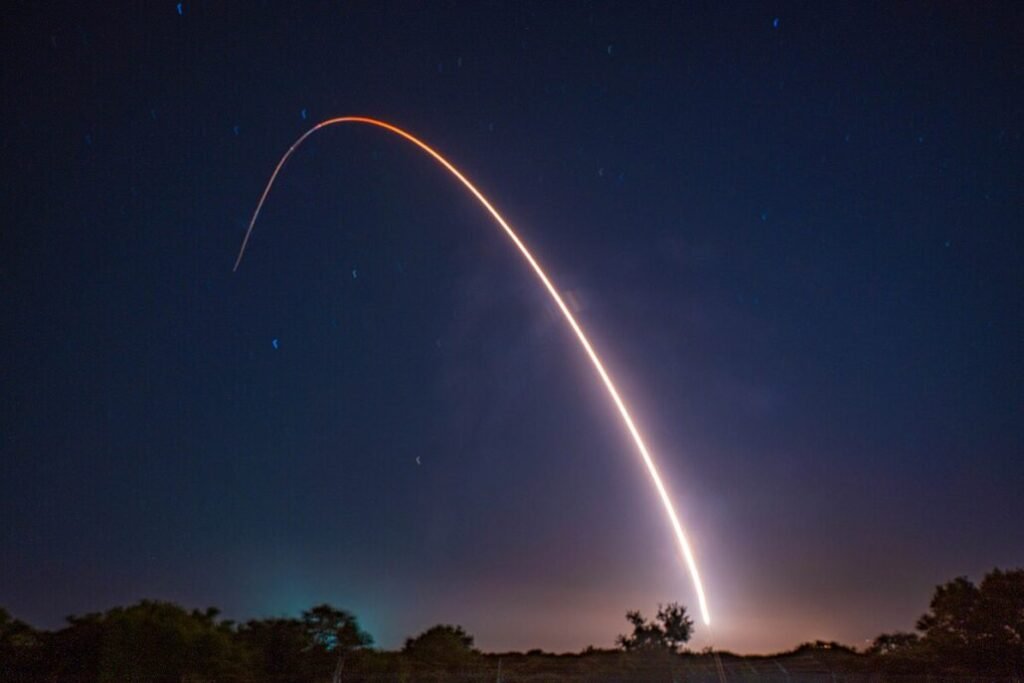
Air Force Global Strike Command (AFGSC) successfully launched an unarmed Minuteman III intercontinental ballistic missile from Vandenberg Space Force Base, California, on November 5, 2025. Designated GT 254, the test assessed the system’s continuity, operational readiness, and accuracy. The Minuteman III remains one of the core elements of the United States’ strategic deterrence posture.
The launch was initiated using the Airborne Launch Control System aboard a U.S. Navy E-6B Mercury, validating the effectiveness of this backup command-and-control capability, which remains essential for the ICBM force.
Test Timing Not Linked to Recent Geopolitical Developments
The timing of GT 254 is not connected to Russia’s recent tests of the 9M730 Burevestnik nuclear-powered cruise missile or the Poseidon nuclear-capable torpedo, nor to President Donald Trump’s announcement regarding plans to resume nuclear weapons testing. AFGSC emphasizes that Minuteman III tests are scheduled years in advance and are part of a longstanding, routine evaluation program. This approach highlights the stability and long-term planning that underpin the U.S. ICBM readiness posture.
Commanders Highlight Reliability and System Integrity
Lt. Col. Karrie Wray, commander of the 576th Flight Test Squadron, stated that the test provided a comprehensive validation process and generated critical data for maintaining system reliability. Col. Dustin Harmon, commander of the 377th Test and Evaluation Group, noted that the assessments yielded important insights into the system’s modularity and durability. The group, the Air Force’s only dedicated ICBM test organization, oversaw all planning and execution activities with precision.
4,200-Mile Flight and Advanced Data Collection
The missile’s reentry vehicle traveled approximately 4,200 miles before reaching the Ronald Reagan Ballistic Missile Defense Test Site at the Kwajalein Atoll in the Republic of the Marshall Islands. The site’s advanced radars, optical sensors, and telemetry systems collected detailed data during the terminal phase of flight. RTS analysts will use this information to support research, development, and future test activities related to U.S. defense and space programs.
Task Force Operations and the Minuteman III’s Strategic Legacy
Airmen from all three AFGSC missile wings supported the launch, while maintainers from F.E. Warren Air Force Base in Wyoming provided essential technical support. This effort underscored the expertise and coordination required to sustain the Minuteman III enterprise.
The Minuteman III was the first U.S. ICBM capable of carrying Multiple Independent Reentry Vehicles (MIRVs) and can deploy three warheads against separate targets. Developed under the “flexible response” strategy, it differs from earlier Minuteman models tied to “massive retaliation” and “controlled response.” Its improved guidance system reduced the need for higher-yield warheads, allowing flexibility and increased targeting precision.
The United States once deployed more than 700 Minuteman III missiles. Today, over 400 remain on alert across bases in Montana, North Dakota, and Wyoming.
Minuteman III Maintains Its Role as the Sentinel Era Approaches
AFGSC Commander Gen. S.L. Davis emphasized that maintaining the Minuteman III’s readiness remains essential, even as the Air Force transitions to the new LGM-35A Sentinel weapon system. Davis noted that GT 254 helps fulfill that commitment by reinforcing the missile’s reliability and accuracy.
As Sentinel development progresses, the Minuteman III will continue to serve as a vital component of the U.S. nuclear deterrence structure.