
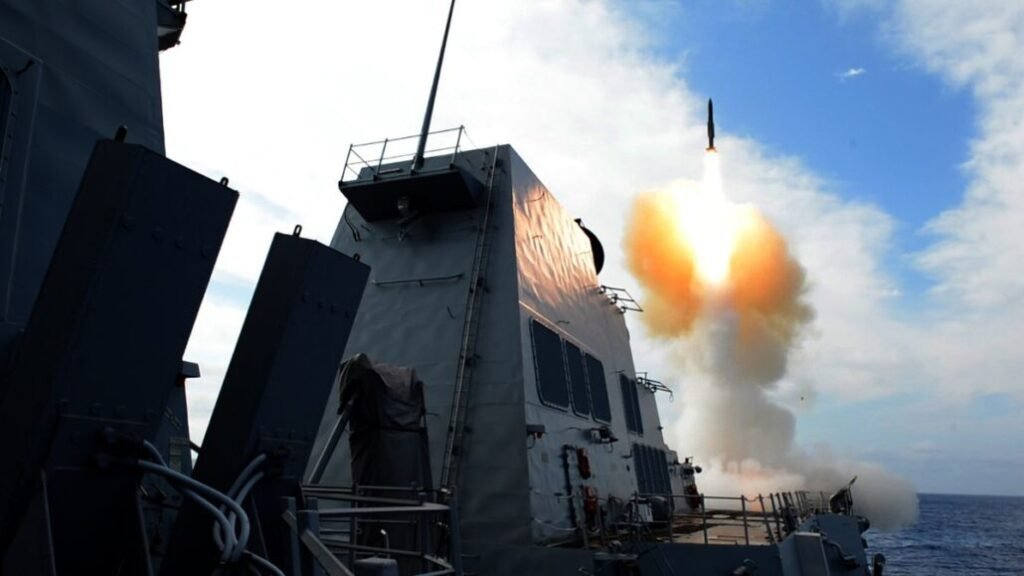
WASHINGTON, November 15, 2025 – The U.S. State Department has approved a potential $3.5 billion Foreign Military Sale to Germany, covering Standard Missile 6 (SM-6) Block I and Standard Missile 2 (SM-2) Block IIIC missiles, along with associated launch and support equipment. The Defense Security Cooperation Agency has submitted the required certification to Congress.
Germany seeks to acquire up to 173 SM-6 Block I and 577 SM-2 Block IIIC missiles. The package also includes MK 21 and MK 13 Vertical Launch System (VLS) canisters, missile transport and storage units, test and training materials, and full engineering and sustainment support. These acquisitions aim to equip Germany’s future F127-class surface combatants with modern Aegis air and missile defense systems.
The SM-2 series offers solid-fueled, tail-controlled interceptors for high-speed aerial threats, launched from either Mk 41 VLS or Mk 26 GMLS. Block II introduced enhanced signal processing to resist electronic warfare, upgraded propulsion and warheads for more effective target engagement. Block III variants, including IIIA and IIIB, extend interception range, improve performance against low-altitude targets, and integrate infrared guidance to complement radar homing systems.
The SM-6 missile provides a multi-role capability, performing anti-air, anti-surface, and ballistic missile defense missions. It can neutralize manned and unmanned aircraft, cruise missiles, surface targets, and ballistic missiles during their terminal phase. The U.S. Navy has deployed over 500 SM-6 missiles across 60 surface ships. Final assembly and testing occur at Redstone Arsenal in Huntsville, Alabama, leveraging decades of proven missile technology.
Additional items in the sale include specialized handling and test equipment, training aids, technical publications, engineering and logistics support, and full life-cycle sustainment. RTX Corporation will serve as the main contractor, with facilities in Camden, AR; Tucson, AZ; and Huntsville, AL.
U.S. officials emphasize that Germany can seamlessly integrate these systems, bolstering NATO’s collective defense without disrupting the regional military balance. The sale enhances Germany’s capability to operate alongside U.S. and allied naval forces, providing a credible deterrent against a wide range of maritime threats while advancing European security and stability.