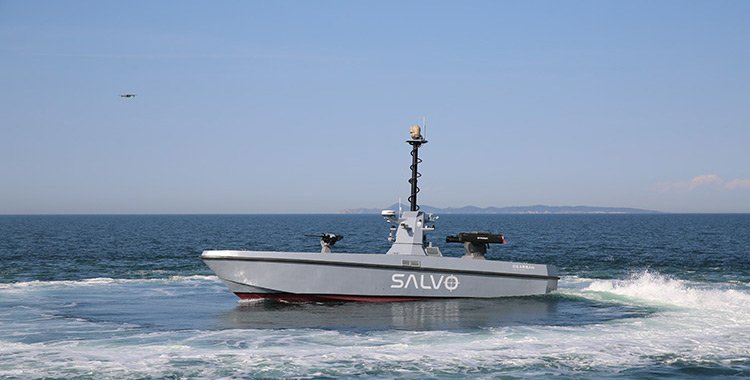
According to reports in the Turkish media on 5 November, the Turkish Naval Forces have officially inducted the SALVO Armed Unmanned Surface Vessel (SİDA) into service under the pennant number TCB 1401. DEARSAN Shipyard built the platform, while UNIROBOTICS supplied the TRAKON LITE remote-controlled weapon station equipped with a CANiK M2 QCB 12.7×99 mm heavy machine gun.
Design and Technical Features
SALVO has a length of 14.79 meters, a beam of 3.83 meters and a draft of 0.75 meters. Its composite hull keeps the vessel light, improves durability and reduces its radar signature. These features make the platform suitable for reconnaissance, surveillance and electronic-intelligence missions. The shallow draft also increases manoeuvrability in tight waters across the Aegean and Eastern Mediterranean.
The vessel reaches speeds above 35 knots and is designed for a maximum of 50 knots. Its transit endurance is around 300 nautical miles, allowing SALVO to support rapid-reaction missions, pursue surface contacts and conduct coastal patrols across wide maritime zones.
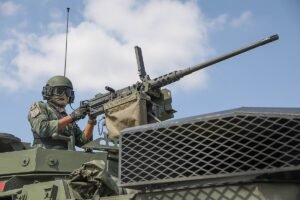
The TRAKON LITE weapon station enables stabilised remote engagement and uses electro-optical and thermal imaging for targeting. It supports calibres ranging from 5.56 mm to 30 mm and is also compatible with 40 mm automatic grenade launchers, offering future flexibility. The CANiK M2 QCB provides strong firepower with its quick-change barrel, allowing continuous operation during extended missions.
During trials in the Sea of Marmara, SALVO successfully fired on a target from a shore-based control station at a distance of 11 kilometres. These tests confirmed the integration of command-and-control, navigation and weapon systems and showed that the vessel can operate effectively in autonomous or remote-controlled modes during high-risk tasks.
Operational Role, Industry Cooperation and Future Growth
SALVO’s mission set includes ISR operations, patrol duty, rapid interdiction, harbour protection and coastal-security missions. The vessel reduces risks for personnel by taking on “dull, dirty and dangerous” tasks. It also supports autonomous and semi-autonomous modes, including follow-me operation alongside manned or unmanned platforms.
The project incorporates broad industrial cooperation. DEARSAN produced the platform, while UNIROBOTICS and CANiK, both part of the SYS Group ecosystem, provided weapon integration and control systems. This structure supports Türkiye’s naval modernisation goals and enhances SALVO’s export potential.
The platform is prepared for future upgrades. Earlier demonstrations showed the integration of ROKETSAN’s CIRIT missile, suggesting possible roles in maritime strike missions and surface warfare. The TCB 1401 configuration provides the structural base for these developments.
SALVO’s entry into service strengthens Türkiye’s littoral-operations capability and supports the country’s broader Blue Homeland maritime-security doctrine. The system has already attracted interest abroad, including demonstrations for Azerbaijan, which points to strong export prospects.