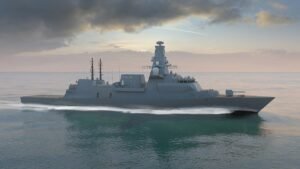
The United States is preparing a major shift in its naval strategy following an announcement made in late December 2025 at former President Donald Trump’s Mar a Lago residence, senior US officials said.
Speaking alongside Secretary of War Pete Hegseth and Secretary of the Navy John C. Phelan, Trump outlined plans to move away from the US Navy’s long standing focus on destroyer based forces in favor of a new concept referred to as the “Golden Fleet.” The initiative calls for the return of heavily armored surface combatants, a class of warship largely absent from US naval doctrine for decades.
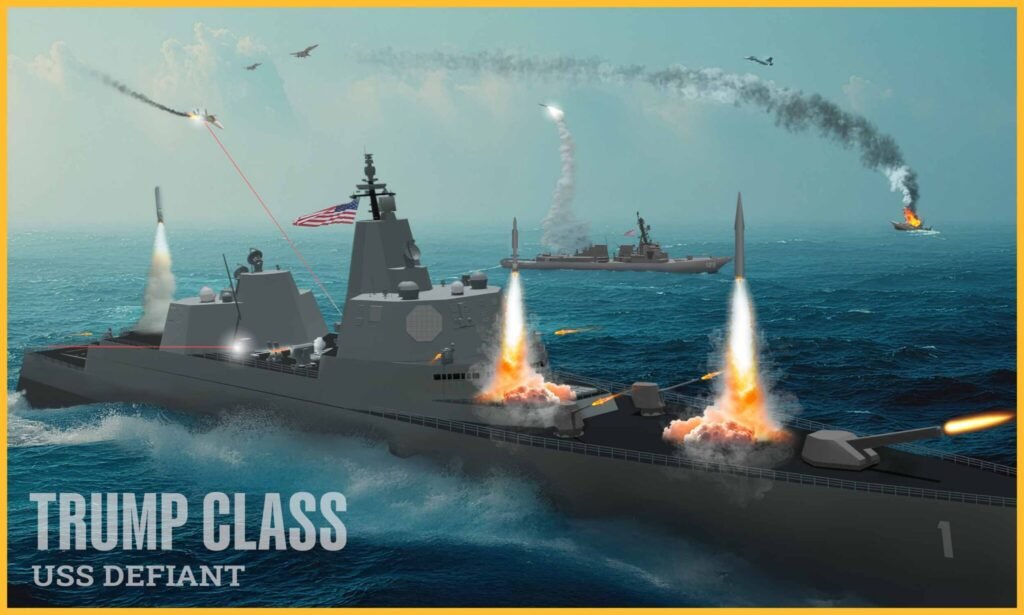
The first vessel of the proposed Trump class ships, to be designated USS Defiant with the hull number BBG 1, is described by the administration as a central element of future American maritime power. Officials said the ship is intended to operate either independently or as a command vessel leading a carrier strike group.
According to Navy officials, USS Defiant would displace approximately 40,000 tons, roughly three times the size of current US destroyers. The ship would be powered by an integrated electrical system derived from technologies developed for the Zumwalt-class, allowing it to supply propulsion, advanced sensors and high energy weapons simultaneously.
Planned armament includes electromagnetic railguns capable of firing projectiles at hypersonic speeds, as well as directed energy weapons, officials said. The ship would also carry 12 hypersonic missile launchers and nuclear capable cruise missiles, providing what the Pentagon describes as expanded strike flexibility for naval operations.
Defense officials said the vessel would serve as a command and coordination platform for unmanned air and sea systems. Its flight deck and hangar spaces are designed to support aircraft such as the V-22 Osprey. Artificial intelligence enabled command and control systems would integrate data across maritime, air, subsurface and space domains.
The Golden Fleet initiative is also being promoted as a large scale industrial effort aimed at revitalizing the US shipbuilding sector. South Korea’s Hanwha Group has acquired the Philadelphia Shipyard and announced a $5 billion modernization program focused on robotic production methods and artificial intelligence assisted design.
Pentagon officials said the program is intended to reduce long standing construction delays through closer cooperation with commercial and international partners. As part of the broader restructuring, the Navy plans to replace the canceled Constellation-class frigate program with a new FF(X) frigate based on US Coast Guard designs. Initial deliveries are expected by 2028.
The announcement has triggered debate in Congress. House Armed Services Committee Chairman Mike Rogers and Senator Roger Wicker voiced support for the initiative, arguing that increased naval strength is essential for deterrence. Democrats including Senator Jack Reed and Representative Joe Courtney questioned the cost, survivability and vulnerability of large surface ships in an era of advanced missile threats.
Independent analysts estimate that each Trump class ship could cost between $10 billion and $15 billion, potentially making it among the most expensive surface combatants ever proposed. Despite criticism, administration officials said construction of the first two ships is planned for the early 2030s, with a long term goal of building a fleet of up to 25 vessels.