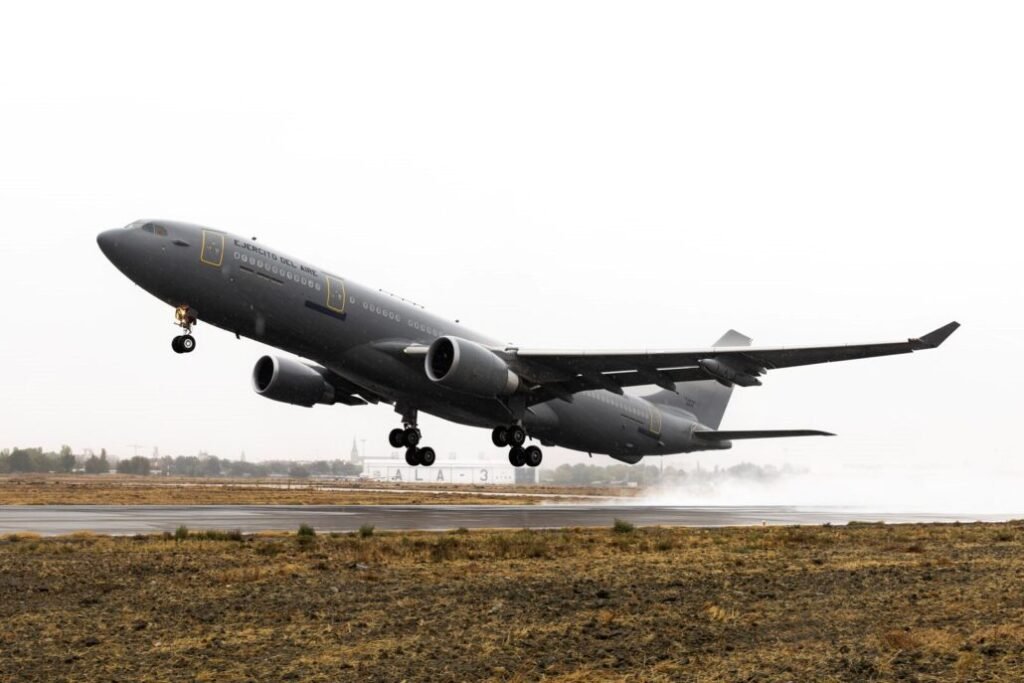
Getafe, 29 October 2025 — Airbus Defence and Space has delivered the second fully converted Airbus A330 Multi Role Tanker Transport (MRTT) aircraft to the Spanish Air and Space Force (Ejército del Aire y del Espacio, EdAE), marking a decisive step in Spain’s strategic air mobility modernization. The delivery, completed at Airbus’s Getafe facility, brings Spain to the verge of achieving full operational capability under its three-aircraft MRTT acquisition program launched in November 2021.
Following the entry into service of the first A330 MRTT in April 2025, the addition of a second aircraft grants EdAE significant operational redundancy. The force can now sustain concurrent long-range missions and aerial refueling operations — even if one aircraft is under maintenance — supporting both national requirements and commitments under the European Air Transport Command (EATC) and NATO frameworks.
Rapid Recovery from a Strategic Capability Gap
Spain’s MRTT program represents a swift and effective recovery from a major capability void that emerged after the retirement of Boeing 707 tankers in 2016. Within just the first half of 2025, the country moved from having no strategic refueling aircraft to fielding two next-generation platforms. This transformation underscores Spain’s confidence in European industrial capacity and the effectiveness of Airbus’s military conversion infrastructure.
The A330 MRTT conversions were conducted entirely at Airbus Defence and Space’s Getafe site — a hub that has evolved into a European center of excellence for large aircraft military modifications. The process includes the integration of wing-mounted hose-and-drogue refueling pods, advanced digital refueling control systems, and structural preparation for future installation of the Advanced Refuelling Boom System (ARBS).
By localizing the conversion process, Spain not only strengthens its domestic industrial base but also ensures long-term autonomy in maintenance, repair, and overhaul (MRO) activities, reducing dependence on external contractors.
From Civil Airliners to Strategic Assets
The program originated from a 2021 agreement to acquire and convert three second-hand Airbus A330-200 airframes previously operated by Iberia, Spain’s national flag carrier and largest airline. Before their conversion, these aircraft were used by Ala 45 in Torrejón for strategic transport missions, supporting operations such as the Pacific Skies 2024 multinational exercise and civilian evacuations from Niger and Sudan.
This interim use reflected an efficient procurement strategy — maximizing operational utility while conversions were underway. The reuse of existing airframes reduced both cost and transition risk, allowing EdAE to maintain continuous strategic lift capability throughout the process. The third and final aircraft is scheduled for delivery in 2026, at which point Spain expects to reach Full Operational Capability (FOC).
A Multi-Role Force Multiplier
The A330 MRTT serves as a tri-role platform capable of aerial refueling, long-range transport, and medical evacuation. With a total internal fuel capacity of 111 tons, the aircraft can refuel allied fighters and transports using wing-mounted hose-and-drogue pods at a rate of 1,300 kg per minute, without the need for additional fuel tanks.
Each MRTT can carry up to 300 personnel or 45 tons of cargo, offering strategic airlift across 14,800 kilometers (8,000 nautical miles). The widebody design also allows rapid reconfiguration into a medical evacuation (MEDEVAC) layout, supporting humanitarian and crisis response missions with intensive care modules and stretcher facilities.
Spain’s MRTTs retain the structural fittings for ARBS integration, enabling future interoperability with boom-receptacle aircraft such as U.S. F-15s and F-16s. This phased approach aligns with European operational needs while preserving flexibility for future doctrinal shifts or acquisitions, such as potential F-35 procurements.
Operational Integration and European Cooperation
Both of Spain’s MRTTs are operated by Ala 45, based at Torrejón Air Base near Madrid. The first aircraft immediately entered operational service under EATC command in April 2025, supporting EU Operation Atalanta off the Horn of Africa.
Through EATC, Spain’s MRTTs contribute directly to multinational air transport and refueling missions, optimizing shared resources among European allies. Although Spain is not a member of NATO’s Multinational MRTT Fleet (MMF), its aircraft share the same configuration, enabling full interoperability in joint logistics and operations.
Spanish Defence Minister Amparo Valcarce described the MRTT capability as “a direct contribution to strengthening the European pillar within NATO,” underscoring Spain’s intent to combine national autonomy with allied solidarity.
Strategic Impact: From Dependence to Autonomy
The arrival of the second MRTT marks the effective end of Spain’s long-standing reliance on allied tankers for extended-range deployments. Replacing the retired KC-130H and Boeing 707 fleets, the A330 MRTTs offer unmatched endurance and capacity — delivering up to 111 tons of transferable fuel compared to the 40–50 tons of legacy aircraft.
This leap enables EdAE to sustain simultaneous operations across the Mediterranean, Africa, and the Indo-Pacific, positioning Spain as a credible contributor to European and global security missions. However, full strategic flexibility and optimal EATC contribution will be realized only after the delivery of the third aircraft in 2026.