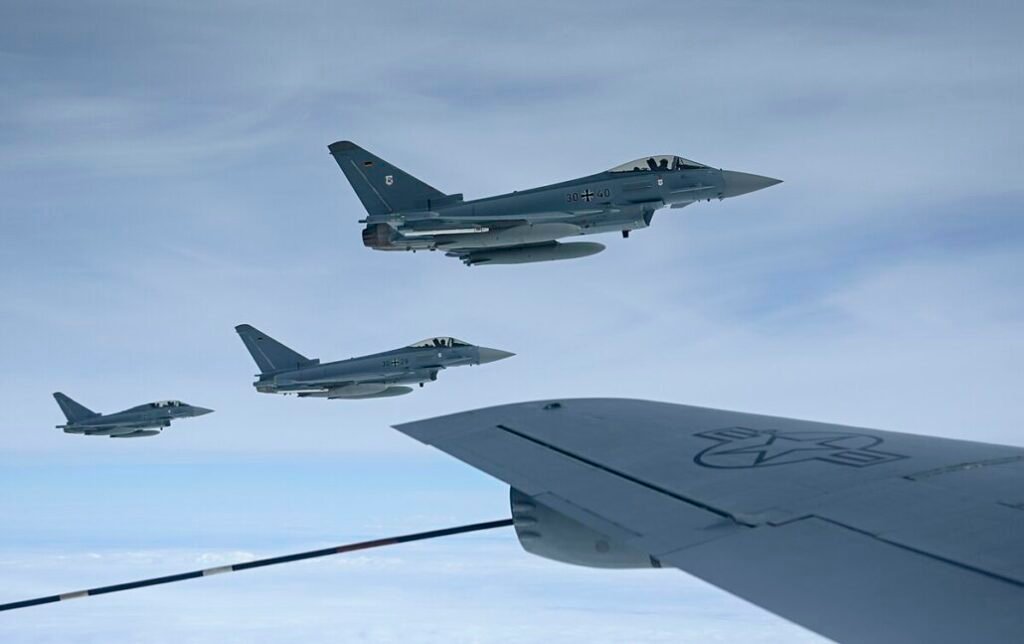
Swedish defense and security company Saab has received two significant orders from Airbus Defence and Space to equip the German Eurofighter aircraft. These orders will considerably enhance the electronic warfare capabilities of the German Air Force (Luftwaffe). Announced on 14 November 2025, the total value of these contracts is approximately €549 million. The contracts confirm the German Eurofighter EK (Elektronischer Kampf – Electronic Warfare) program, which will take over the role of the aging Panavia Tornado ECR fleet.
Saab recorded this total investment amount in two separate orders. The first order is valued at approximately €291 million, which has been immediately booked in its accounts. This first contract is a continuation of the existing agreement for the integration of the Arexis sensor suite, signed in March 2024. The second order is worth approximately €258 million and is subject to approval by the relevant authorities. This second package includes artificial intelligence (AI) technology developed by Saab’s strategic partner, Helsing. This distinction reflects Germany’s risk management strategy regarding advanced technology components.
Saab will complete deliveries of the Arexis sensor suite from 2025 through 2028. This accelerated schedule reinforces Germany’s objective to rapidly regain electronic warfare capability. The Air Force plans to gradually retire Tornado ECR aircraft from 2030 onward. Accordingly, Airbus aims to make the Eurofighter EK version fully operational by 2030. In the first phase of the program, the existing 15 Eurofighter aircraft will be converted to this special EK standard.
The technology underlying the Arexis system provides superiority against modern electronic warfare threats. Saab President and CEO Micael Johansson describes Arexis as “one of the most advanced fully digital sensor and jamming systems on the market.” The system is designed for electronic attack and self-protection operations. Technically, it employs high-power Gallium Nitride (GaN)-based Active Electronically Scanned Array (AESA) transmitters. Arexis also features ultra-wideband digital receivers and Digital Radio Frequency Memory (DRFM) devices. These capabilities enable the system to detect all emitters in real time and locate them in complex signal environments. Thanks to DRFM technology, Arexis can generate intelligent noise and coherent false targets. These techniques are critical for countering low-frequency radars used by modern anti-stealth air defense systems.
Integration into the Eurofighter requires a significant modification to the aircraft’s existing structure. The Arexis suite will replace the current Defensive Aids Sub-System (DASS) in the wingtip pods. These new pods will provide the aircraft with effective electronic attack and self-protection capabilities. Germany conducted a market study considering factors such as performance and integration ease before making this decision. Moreover, the German defense industry regains the SEAD/DEAD (Suppression/Destruction of Enemy Air Defenses) capability, a core mission of the Eurofighter EK, through Arexis.
The most forward-looking feature of the system is the inclusion of artificial intelligence technology developed with Germany’s strategic partner, Helsing. These state-of-the-art AI algorithms assess threats in real time while minimizing the pilot’s workload, allowing the crew to focus on mission tasks. Thanks to its modular structure and intelligent software, Arexis can be easily integrated into almost any modern platform. This collaboration strengthens the Swedish-German partnership while ensuring Germany maintains sovereign control over this sensitive technology. Saab will carry out a significant portion of the work in its facilities in Bavaria, Germany, in partnership with Helsing.
In conclusion, this investment solidifies the strategic trajectory of the Eurofighter. Arexis integration positions the Eurofighter as a 4.5+ generation combat aircraft capable of surviving in high-intensity conflict environments. In addition to Germany’s F-35A procurement, this emphasis on electronic superiority demonstrates the maturation of a multi-layered air combat doctrine within NATO. These significant upgrades will ensure the Eurofighter remains operational into the 2060s, providing a technological bridge to the Future Combat Air System (FCAS). By bearing the integration costs, Germany has also paved the way for other Eurofighter users to benefit from this technology in the future.