
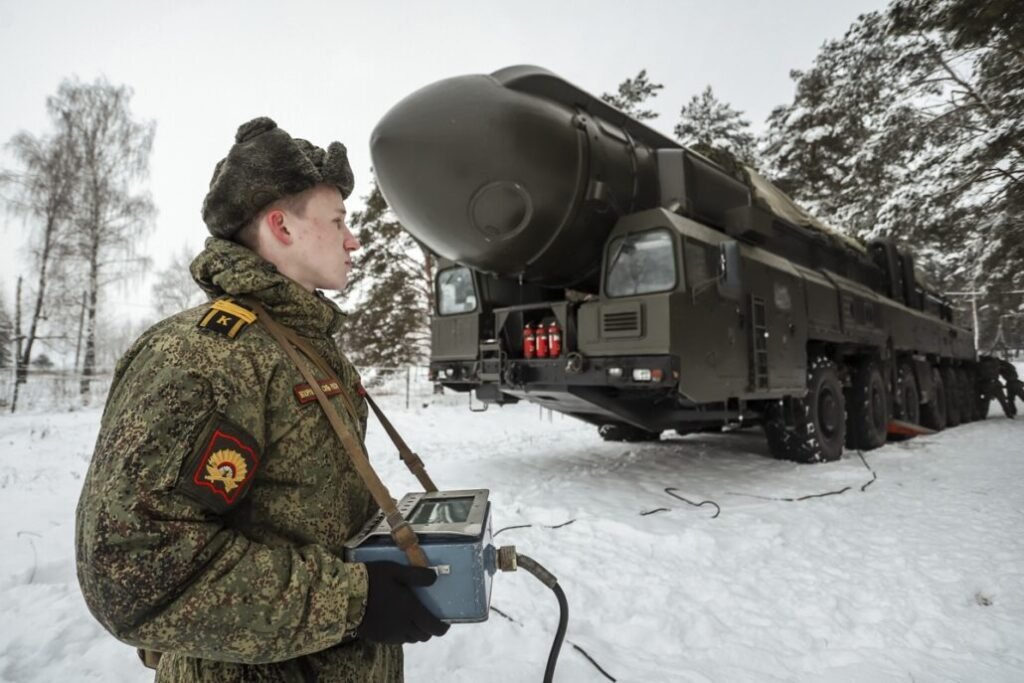
Russian President Vladimir Putin announced that his country has successfully completed the “decisive tests” of its nuclear-powered, nuclear-capable cruise missile 9M730 Burevestnik (NATO designation: SSC-X-9 Skyfall). The announcement coincided with the Thunder annual strategic nuclear forces exercise, which encompasses all components of Russia’s nuclear triad.
Russian Chief of the General Staff, General of the Army Valery Gerasimov, personally reported the results of the key test conducted on Tuesday, October 21, to President Putin. Gerasimov stated that the missile remained in flight for 15 hours and traveled approximately 14,000 kilometers (8,700 miles), emphasizing that this duration “is not a limit.” This achievement makes Burevestnik unique in terms of range, potentially capable of reaching nearly every continent.
Speaking at a meeting in military uniform, Putin highlighted this strategic success, stating: “This is truly a unique weapon, a weapon that no other country in the world possesses.” Noting the challenges during the development process, he added, “Russian experts said this weapon would never be possible, yet now we have completed its critical tests.” When first unveiled in 2018, Putin’s threatening rhetoric criticized the West for ignoring Russia’s security concerns, summarizing the project’s primary objective: “No one wanted to listen to us. So now, listen.”
Following the completion of the tests, President Putin ordered the preparation of the necessary infrastructure for the missile’s induction into military service and the classification of the weapon. Analysts say the move aims to enhance Russia’s nuclear deterrence capabilities and serve as a display of strength in negotiations with the West.
Russia’s nuclear message has drawn sharp reactions from the West as the conflict in Ukraine approaches its fourth year. Former U.S. President Donald Trump described Russia’s action as “inappropriate,” emphasizing that instead of conducting missile tests, Putin should focus on ending the war in Ukraine: “A war that should have lasted a week is now approaching its fourth year. What he should do instead of testing missiles is this.” NATO officials also warned that the missile tests send a “serious signal of threat” to the security balance in Europe.
The most destructive aspect of the Burevestnik project lies in the environmental hazard posed by its nuclear propulsion system. Experts note that the missile employs an open-cycle reactor, which generates thrust by passing air directly through the nuclear core. This design means the missile continuously emits radioactive exhaust during flight. Former senior U.S. State Department official Thomas Countryman described the weapon as “uniquely foolish,” likening it to a “flying Chernobyl.”
The radiological risk was demonstrated in August 2019 during a test at Nyonoksa, where an explosion believed to be associated with Burevestnik killed at least five scientists and caused a sudden spike in local radiation levels. Following this launch, the Norwegian Radiation Protection Authority stated that, initially, no abnormal readings were detected at its stations; however, in the event of radioactive release during the missile’s 14,000-kilometer flight, it would take time for the plume to reach Scandinavia.
In conclusion, Burevestnik not only complicates NATO’s defense planning but also, through its environmental catastrophe threat to nuclear deterrence, necessitates the fundamental rewriting of any future arms control agreements. The success of the test should be read as a dangerous precedent, a demonstration of Russia’s coercive diplomacy that disregards international norms and environmental security.