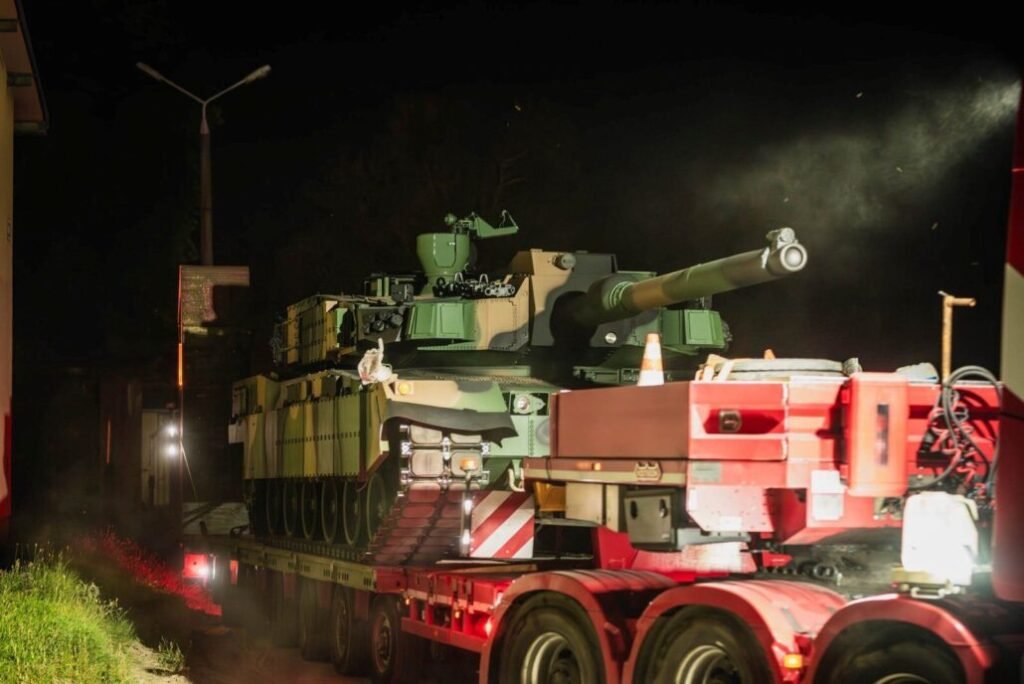
On November 13, 2025, Poland received the final batch of 20 K2 Black Panther tanks for its 16th Mechanized Division, completing the first contract signed in August 2022. Deputy Prime Minister and Minister of National Defense Władysław Kosiniak-Kamysz announced on social media that the delivery marked the fulfillment of all 180 tanks ordered under the initial agreement. He added that the next contract, signed in August 2025, will include tanks produced in Poland as well.
The framework agreement for the K2 tank acquisition was approved on July 27, 2022, in Warsaw. The Polish side, represented by the Armament Agency, and the South Korean side, Hyundai Rotem, agreed on the procurement and delivery schedule. The August 2022 implementation contract, valued at $3.37 billion net, covered 180 tanks to be delivered between 2022 and 2025. It also included a comprehensive training and logistics package, a large ammunition stockpile, and service support in Poland starting with the first deliveries.
The logistics package included spare parts, specialized tools, and diagnostic equipment. The training program provided Embedded Training System (ETS) simulators and crew and technical personnel instruction in both South Korea and Poland. The contract ensured that Polish crews would be fully prepared to operate the K2 tanks effectively.
In August 2025, Poland signed the second implementation contract in Gliwice. The new agreement covers the delivery of another 180 K2 tanks between 2026 and 2030. Of these, 116 will be delivered in the existing K2GF configuration between 2026 and 2027, while 64 tanks will feature the new K2PL configuration and arrive between 2028 and 2030. Production of 61 K2PL tanks will take place at Zakłady Mechaniczne “Bumar-Łabędy” in Poland, while the first three units will be manufactured and tested in South Korea to implement configuration improvements.
The second contract also provides for the acquisition of accompanying support vehicles based on the K2 chassis. Polish defense industry companies, including OBRUM and Bumar-Łabędy, will participate in their design and production. Deliveries will include 31 technical support vehicles, 25 engineering vehicles, and 25 bridge-laying vehicles between 2029 and 2031. The agreement covers logistics, training, and a significant ammunition stockpile. The logistics package will provide spare parts, test equipment, maintenance tools, and technical documentation. The training package includes training ammunition, ETS simulators, and instructor and crew training.
The K2 Black Panther is a South Korean third-generation-plus main battle tank. Its main armament is a 120 mm smoothbore gun with an automatic loader capable of firing advanced ammunition. Secondary armament includes a 7.62 mm machine gun and a 12.7 mm heavy machine gun. The tank’s advanced fire-control system ensures high accuracy at long ranges.
Standard K2 armor, enhanced with active soft-kill (VIRSS) and hard-kill (KAPS) systems, provides high ballistic and mine protection. A 1,500-horsepower diesel engine and automatic transmission deliver speed and mobility across all terrains. The tank’s 55-ton weight and hydropneumatic suspension ensure superior maneuverability.
All K2 tanks will integrate with Polish Armed Forces communication systems and the BMS battlefield management system, compatible with the M1A2 Abrams tanks. The K2PL configuration will include additional armor, an all-around observation system, the Active Vehicle Protection System (ASOP), programmable ammunition compatibility, and a Polish 12.7 mm heavy machine gun. These upgrades reflect operational lessons learned from K2GF tank deployment.
The second contract also establishes a technology transfer program, allowing Polish defense companies to develop full production, assembly, and maintenance capabilities. Hyundai Rotem will equip Bumar-Łabędy with production tools and establish a K2PL and support vehicle assembly line in Poland.
Poland’s K2 Black Panther program significantly strengthens its land forces. By modernizing its tank fleet and building domestic production capabilities, the country enhances its strategic position and regional security.