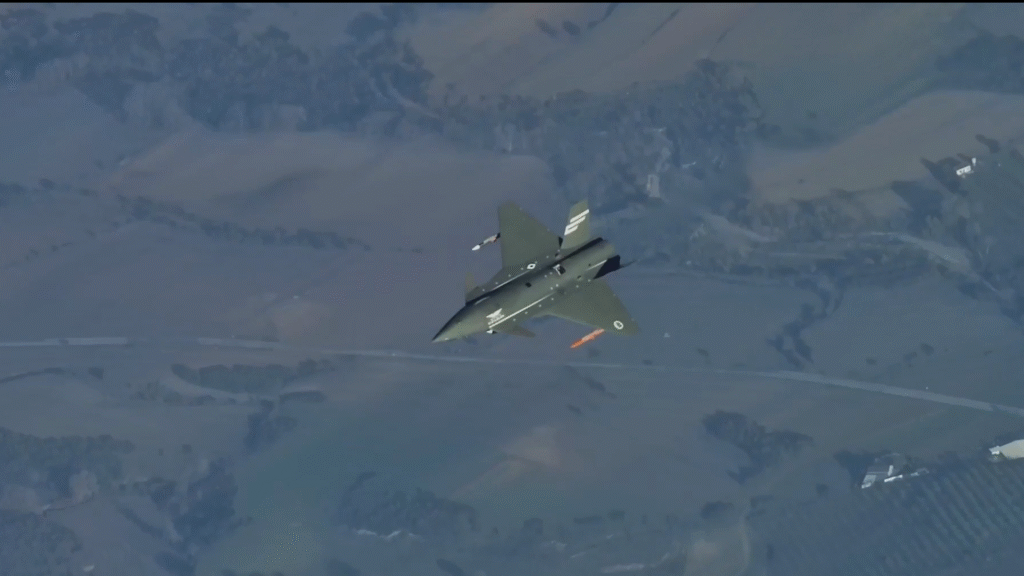
Türkiye’s first jet-powered unmanned combat aircraft (UCAV), the Bayraktar KIZILELMA, marked a significant technical stage in aviation with a test flight conducted near the Sinop Firing Area over the Black Sea on November 30, 2025. In this test, KIZILELMA launched a Beyond-Visual-Range (BVR) air-to-air missile against a jet-powered, high-speed target aircraft and achieved a direct hit. Company officials stated that this engagement constitutes a global first because it is the first verified instance of an autonomous jet platform executing a BVR air-to-air strike. This achievement distinguishes it from international programs that are either in the concept phase or limited to short-range tests (such as the XQ-58A Valkyrie or Wing Loong-3) , signaling significant progress in Türkiye’s goal of leading the implementation of next-generation air combat doctrines.
The design of KIZILELMA was developed to overcome the speed and altitude limitations of conventional UAVs, offering a kinematic profile similar to that of combat aircraft. The platform, which can currently achieve near-supersonic speeds and has a maximum speed of Mach 0.9, possesses a maximum take-off weight of 8.5 tons and a payload capacity of 1.5 tons. The ability of the aircraft to operate at a service ceiling of 45,000 feet is a critical design choice, as it provides the necessary kinetic energy (speed and altitude) to optimize the range and effectiveness envelope of long-range BVR missiles. The airframe’s low radar cross-section (RCS) and autonomous take-off/landing systems increase KIZILELMA’s flexibility for both air superiority missions and operations from short-runway vessels like the TCG Anadolu.
The foundation of this successful engagement is the locally developed integrated sensor and weapon system. Target detection and tracking were performed by the ASELSAN-produced MURAD Active Electronically Scanned Array (AESA) Radar system. This radar, which has a solid-state architecture based on GaN (Gallium Nitride) technology, features agile electronic beam steering and multi-target tracking capability. These features allowed KIZILELMA to provide the precise and continuous target data necessary for BVR missile guidance. In a previous test, the radar had successfully detected and locked onto a maneuvering F-16 target at a distance of 30 miles and executed a simulated shot.
The kinetic striking power was the TÜBİTAK SAGE GÖKDOĞAN Beyond-Visual-Range Air-to-Air Missile (BVRAAM), an active radar-guided system with a range exceeding 65 kilometers. The missile carries features such as fire-and-forget capability, as well as lock-on-after-launch (LOAL) capability and the ability to receive mid-course guidance updates via datalink. These features required the instant transmission of critical data from the KIZILELMA platform to the missile, and the successful completion of this process demonstrated the high maturity level of the indigenous kill chain integration.
The live-fire test in Sinop was conducted within a complex Manned-Unmanned Teaming (MUT) concept, with KIZILELMA flying in formation alongside five Turkish Air Force F-16s. This coordinated operation represents a practical application of future air combat doctrines, allowing unmanned platforms to support manned aircraft as “loyal wingmen” by leveraging their low observability and long-range engagement capability to enhance safety and expand combat capacity. KIZILELMA’s verified capability in this domain reinforces Türkiye’s progress in autonomous air combat capabilities in an environment where international development programs, such as the US XQ-58A Valkyrie, have not yet verified a BVR strike on this scale. This complete indigenous system integration is also regarded as an indicator of the country’s effort to achieve strategic independence in critical defense technologies.