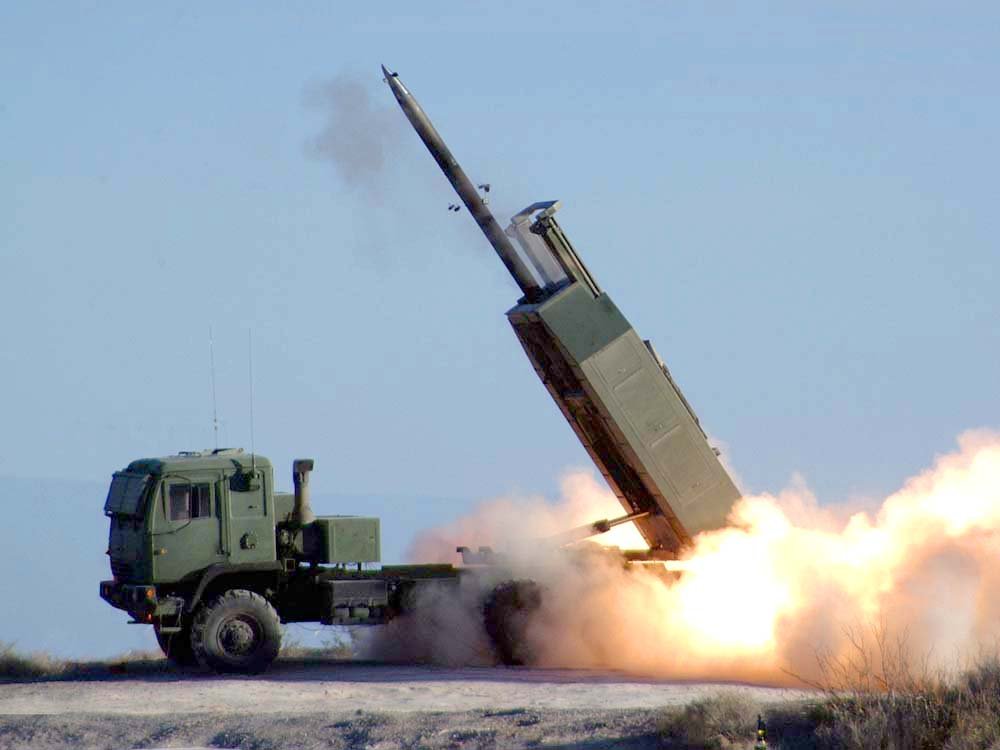
Lockheed Martin delivered its 750th M142 High Mobility Artillery Rocket System (HIMARS) on 5 November, marking a major milestone for one of the most influential precision-strike launchers in modern warfare. The achievement highlights the rapid expansion of U.S. production capacity and the system’s growing impact across multiple global conflict zones.
Developed in the late 1990s, the M142 HIMARS is a light multiple rocket launcher mounted on the FMTV M1140 five-ton truck frame, providing high mobility and rapid shoot-and-scoot capability. The system carries one interchangeable pod capable of launching either six GMLRS rockets or one ATACMS missile, fully compatible with the entire MLRS Family of Munitions. Unlike the tracked M270, which mounts two pods, HIMARS carries one and uses a wheeled chassis to reduce weight and increase mobility. Its windows use sapphire-glass-polycarbonate laminates, offering improved ballistic resistance.
In its early years, the system was even tested as a unified launcher for artillery rockets and the SLAMRAAM surface-launched AMRAAM, demonstrating its modular potential. In 2017, the U.S. Marine Corps fired a HIMARS from the deck of USS Anchorage, proving the system could deliver precision fire from ships after software modifications allowed accurate firing while afloat.
Meeting Modernization Goals
“HIMARS embodies what modern fires demand – reliability, accuracy and survivability,” said Carolyn Orzechowski, vice president of Lockheed Martin Precision Fires Launchers and Missiles. The system now anchors the U.S. Army’s long-range precision fires modernization strategy, supporting next-generation munitions including PrSM and Extended-Range GMLRS.
The Army’s modernization roadmap prioritizes rapid manufacturing and resilient supply chains. In response, Lockheed Martin expanded its Camden, Arkansas facility—doubling annual production from 48 to 96 launchers, achieving the increase two months early. Backed by $2.9 billion in Army contracts, the expansion includes new tooling, advanced automation, streamlined logistics and increased workforce capacity.
“Speed matters—not just in the field but on the factory floor,” Camden site director Adam Bailey said, emphasizing that improved workflows and industrial resilience now allow faster deliveries to U.S. and allied forces.
Operational Combat Record
HIMARS entered U.S. Army service in June 2005, with earlier prototypes already used during the Iraq War. The system later saw extensive operations across Afghanistan, Iraq, and Syria, conducting thousands of precision strikes on ISIL targets from positions located in Jordan, Türkiye’s border area, Qayyarah Airfield, the Omar oilfields, and other forward bases.
Key operational highlights include:
- 2010 Afghanistan (Operation Moshtarak): A temporary suspension occurred after rockets reportedly fell short; later investigations reinstated HIMARS use.
- 2015–2018 Middle East: Over 400 rockets fired at ISIL targets; major strikes included a 14-second triple hit that killed 50 Taliban fighters in Musa Qala.
- Syria (2016–2018): Up to 30 GMLRS strikes per day supported the SDF in the Deir ez-Zor campaign.
Ukraine: A Defining Battlefield
Ukraine received its first HIMARS in June 2022, immediately using the system to destroy Russian ammunition depots, command nodes, and logistics hubs. By late 2022, Ukraine had struck over 400 high-value Russian targets, degrading artillery output and supply chains.
Notable phases:
- Precision strikes in Izyum, Kherson, Donetsk, and Zaporizhzhia.
- Use of alternative-warhead M30A1 rockets for area effects.
- Russian efforts to jam GMLRS guidance partly mitigated by inertial navigation.
- Rising Russian focus on targeting HIMARS via drones and loitering munitions.
Confirmed losses:
- 1st loss: March 2024, near Nykanorivka.
- 2nd loss: August 2024, Sumy region.
- 3rd loss: May 2025, first HIMARS destroyed by an FPV drone.
- 4th loss: May 2025 near Chasiv Yar, destroyed by the Rubicon drone unit.
Despite these incidents, the majority remain operational, and the system continues to strike deep behind Russian lines. Notable attacks include:
- June 2024: Strikes on S-300/S-400 launchers in Belgorod.
- August 2024: Destruction of a Russian troop convoy in Kursk Oblast.
- September 2025: Strike on Belgorod thermal power plant causing a regional blackout.
Global Impact and Allied Expansion
Today 14 partner nations operate HIMARS, reinforcing NATO and Indo-Pacific deterrence architectures. The same U.S. production line supports allied orders, providing interoperability across joint operations. “Every bolt, wire and weld connects our workforce here in the U.S. to soldiers and allies overseas,” Bailey said. Lockheed Martin notes that small businesses across the U.S. supply key components, strengthening domestic industrial capacity.
The delivery of the 750th HIMARS reflects two decades of combat experience, continuous modernization, and growing global reliance on mobile long-range precision fires. As next-generation munitions enter service and production capacity continues to rise, HIMARS remains a defining asset for modern warfare, from the Indo-Pacific to the Eastern Front.