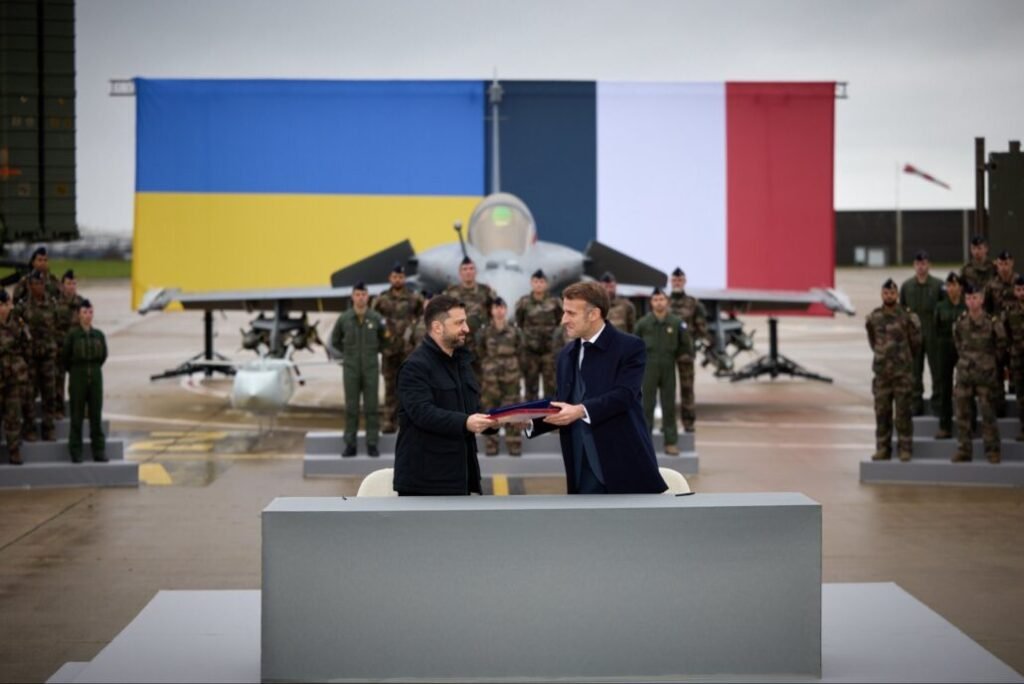
PARIS, Nov. 17, 2025. Ukrainian President Volodymyr Zelensky’s visit to Paris on Monday concluded with a landmark defense agreement that could reshape Europe’s future security architecture. The declaration of intent signed during the visit signals a potential decade-long strategic aviation partnership, including the possible acquisition of advanced French-made Rafale multirole fighter jets.
Before the meetings in Paris, Zelensky had already described the forthcoming commitment as a “historic agreement” that would significantly reinforce Ukraine’s combat aviation and air-defense capability. As the discussions progressed, it became clear that the core objective of the accord is to shift Ukraine’s air force away from aging Soviet-era platforms and toward a modern, NATO-interoperable fleet. French officials confirmed that Ukraine signed a letter of intent to purchase up to 100 Rafale fighters as part of a long-term air force modernization plan envisioning a total fleet of 250 combat aircraft.
The Rafale is positioned as the most advanced element within Ukraine’s “three fighter jet” strategy, which also includes U.S.-made F-16s and Sweden’s Gripen, and is expected to enhance Kyiv’s air-superiority and long-range strike capabilities. Its compatibility with state-of-the-art European munitions, including the long-range Meteor air-to-air missile, is likely to provide Ukraine with a substantial operational edge. Moreover, French officials indicated that while some aircraft could be sourced from France’s existing inventory, the majority would arrive through new production orders. However, they also emphasized that Ukrainian pilots will require an extensive training period before achieving full operational readiness, underscoring the long-term nature of the commitment.
Financially, the deal is set to rely on an unprecedented mechanism designed to overcome Ukraine’s severe budgetary constraints. The acquisition is expected to draw on revenues generated from Russian sovereign assets frozen within the European Union. According to Dassault Group, funding would be channeled through NATO’s “Priority Ukraine Needs List Mechanism,” with the EU using the frozen assets as collateral. This approach aims to leverage approximately €210 billion in immobilized Russian holdings to support Ukraine’s defense-industrial requirements, marking a major institutional innovation in European security policy.
Nevertheless, the deal also introduces significant geopolitical tension. Moscow has repeatedly warned that all Western arms transfers to Ukraine constitute “legitimate targets” for Russian forces, and the prospect of Rafale fighters entering Ukrainian service has intensified Russian rhetoric. At the same time, domestic criticism within France has grown. Figures such as Patriots Party leader Florian Philippot argue that the Rafale transfer sets a “dangerous and costly precedent,” calling for greater transparency and oversight amid longstanding concerns over corruption among Ukrainian officials.
During the Paris talks, both sides also discussed additional measures to reinforce Ukraine’s immediate air-defense needs, particularly in light of increasing Russian missile and drone attacks. These discussions included potential deliveries of additional SAMP/T air-defense systems, associated interceptors, and anti-drone technologies.
Ultimately, the agreement is widely seen as part of France’s broader effort to assert security leadership in Europe at a moment when U.S. military assistance to Ukraine has been suspended. By anchoring Ukraine’s future air force in French and European technologies, Paris aims not only to support Kyiv’s long-term defense resilience but also to reinforce Ukraine’s alignment with NATO standards.