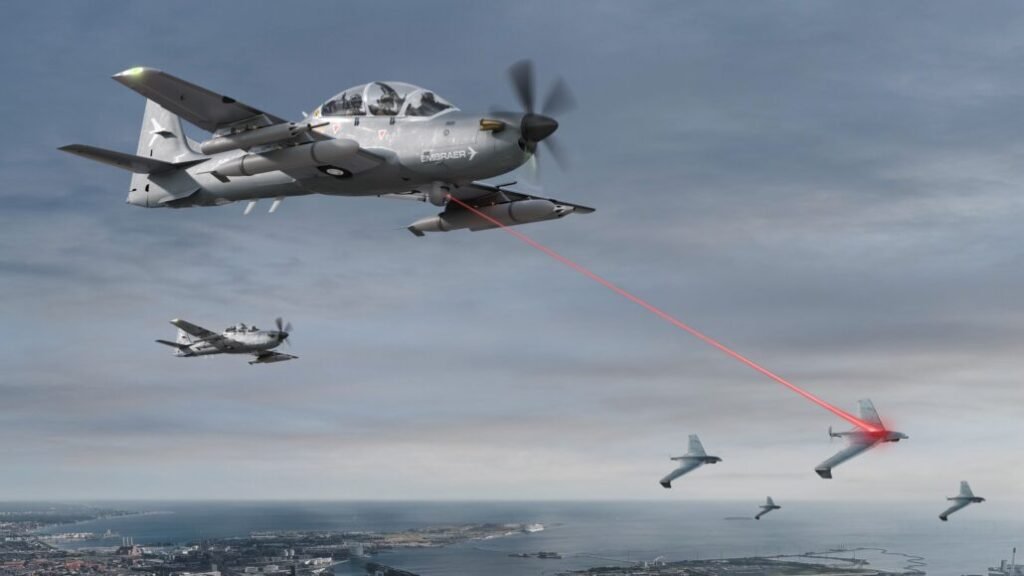
São José dos Campos, November 11, 2025 — Embraer (NYSE: EMBJ / B3: EMBJ3) announced today that its A-29 Super Tucano is now expanding its mission set to address modern unmanned aerial threats efficiently and cost-effectively.
The aircraft leverages existing operational capabilities alongside new sensors, including specialized datalinks for initial target coordinates and queueing, an Electro-Optical/Infra-Red (EO/IR) sensor for laser tracking and designation, wing-mounted .50 caliber machine guns, and laser-guided rockets to neutralize hostile drones. Embraer’s Operational Concept (CONOPS) allows current and future A-29 operators to integrate counter-UAS missions into their profiles whenever needed.
“We continue to expand the A-29’s capabilities to address the latest challenges faced by many nations worldwide,” said Bosco da Costa Junior, President and CEO of Embraer Defense & Security. “Recent conflicts have highlighted the urgent need for effective, low-cost counter-drone solutions. The A-29 provides an ideal platform to meet this demand while maintaining its existing missions, including close air support, armed reconnaissance, and advanced pilot training.”
The A-29 Super Tucano is a rugged, versatile turboprop aircraft designed for operations from forward bases and unprepared airstrips. With a global record exceeding 600,000 flight hours, it is capable of performing advanced pilot training, close air support, air patrol, air interdiction, Joint Terminal Attack Controller (JTAC) training, armed Intelligence, Surveillance, and Reconnaissance (ISR), border surveillance, and air escort missions.
Technical specifications of the EMB 314 include a two-person crew, maximum takeoff weight of 5,400 kg, Pratt & Whitney Canada PT6A-68C turboprop engine producing 1,604 hp, maximum speed of 590 km/h, and a service ceiling of 10,668 meters. Its weapons loadout includes wing-mounted .50 caliber guns, short-range air-to-air missiles like the AIM-9X, guided and unguided rockets, and free-fall bombs, providing broad operational flexibility.
The Super Tucano’s advanced avionics, human-machine interface systems, and robust airframe allow for operations in austere environments without infrastructure support. Its reliability, structural integrity, and low maintenance requirements contribute to a low life-cycle cost, making it a preferred platform for air forces worldwide. Current operators include Afghanistan, the United States, Angola, Brazil, Burkina Faso, the Dominican Republic, Ecuador, Indonesia, Ghana, Honduras, Colombia, Lebanon, Mali, Mauritania, Mozambique, Nigeria, Senegal, and Chile.
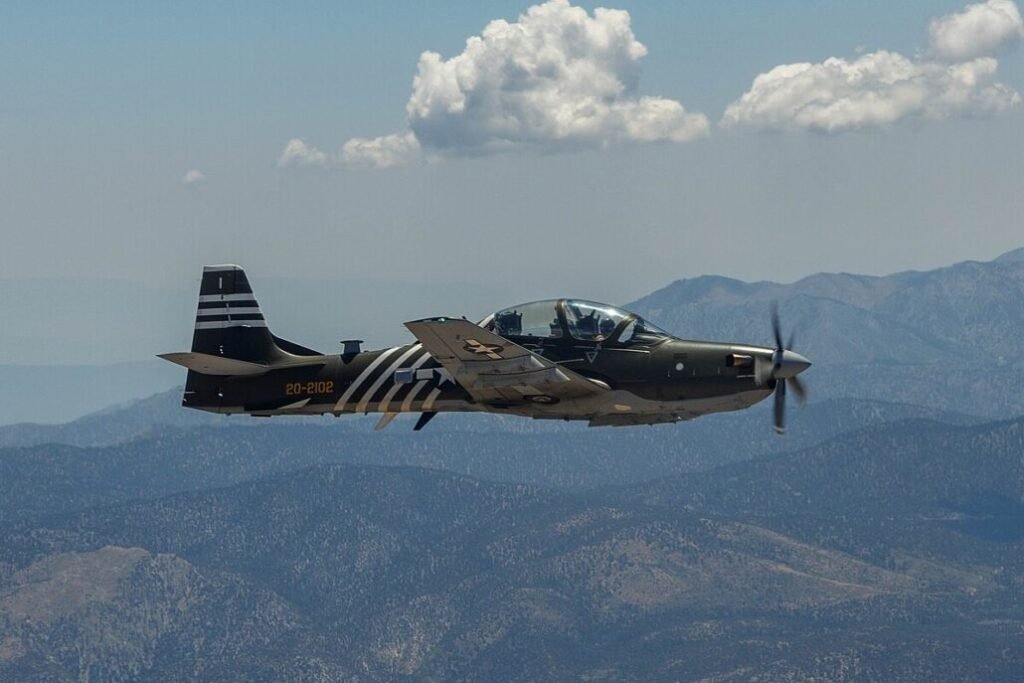
By combining affordability, versatility, and advanced targeting capabilities, the A-29 Super Tucano continues to set the standard for light attack and counter-UAS operations in modern aerial warfare.