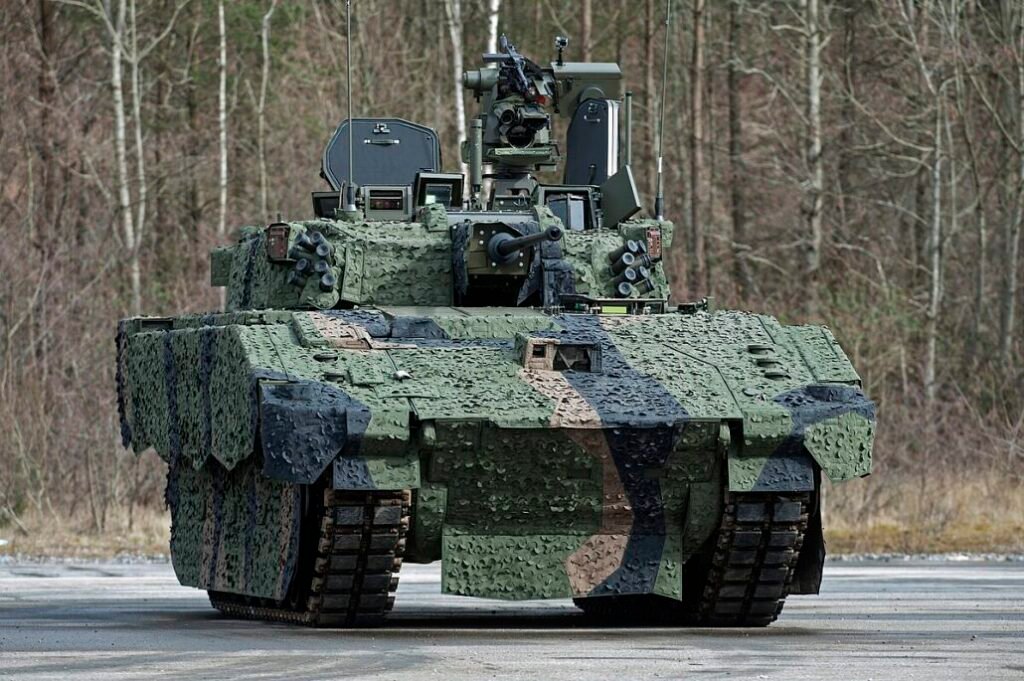
The British Army has announced the first deliveries of the next-generation Ajax armoured fighting vehicles, marking a key milestone nearly eight years later than originally planned. This step gains significance as it represents the first completely new armoured fighting vehicle to enter service in almost thirty years and demonstrates tangible progress in the long-delayed programme.
Developed by General Dynamics UK and produced in Merthyr Tydfil, Wales, the vehicles reflect the work of a wide industrial chain spanning over 230 companies and more than 4,100 employees across the United Kingdom, while continuing to strengthen the defence sector’s role in the national economy. The Ajax vehicles were ordered in 2014, with the first delivery initially scheduled for 2017 and the first unit expected to be fully equipped by 2019. However, the programme faced repeated delays due to serious technical issues during testing. Problems such as excessive vibration, high noise levels, damage to electronic systems, and even hearing and joint problems among crews brought the project into technical and political debate.
After technical issues were addressed, testing resumed in 2022, and the programme gained momentum, described in official statements in 2023 as “turning a corner.” Following successful trials, Ajax finally completed acceptance procedures in early 2025 and began deliveries to the Combat Manoeuvre Centre at Bovington, the Queen’s Royal Hussars at Tidworth, and the Royal Lancers at Catterick. National Armaments Director Rupert Pearce stated that the delivery process provides the UK armed forces with a “transformational capability” developed by thousands of skilled workers.
The Ajax family consists of 589 tracked, all-terrain vehicles across six variants, each based on a common platform. The backbone of the family, 245 AJAX reconnaissance vehicles, performs all-weather intelligence, surveillance, target acquisition, and reconnaissance (ISTAR) tasks. The Ares variant transports specialist teams across the battlefield, Athena manages command-and-control processes, Argus provides engineering reconnaissance, Apollo delivers maintenance and repair support, and Atlas recovers damaged vehicles. This variety demonstrates that the programme is not merely a vehicle supply project but aims for a holistic transformation in battlefield awareness, mobility, and operational continuity.
The platform comes with a new digital backbone, advanced sensors, and a 40mm CT40 cannon capable of high-precision fire. Its mobility relies on a 600–800 hp MTU diesel engine paired with an advanced suspension system that enhances performance on rough terrain. Officials say these improvements will support integrated operations and strengthen cooperation between the British Army and NATO partners.
The vehicles’ operational testing confirmed their technical capabilities. The system fired more than 20,000 rounds and completed over 42,000 kilometres of terrain tests. Crew members emphasized the difference compared to previous CVR(T) systems. Captain John Hutton of the Household Cavalry Regiment said, “Driving AJAX is a really noticeable step change from the previous generation of AFVs. Whilst the pure function remains the same, the control mechanism, the responsiveness of the vehicle and the situational awareness granted to a Driver is unlike anything I have driven before.” Hutton added that 360-degree visibility available to all crew members greatly improves operational safety and ease of control.
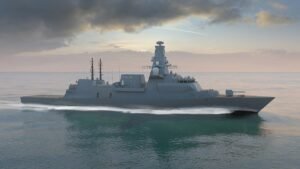
The economic impact of these developments is as notable as their military significance. Ajax not only supports the Army’s modernisation but also contributes to UK defence industry export potential. Government officials confirmed ongoing discussions with various countries, noting that increased interest in the European defence market continues, following recent agreements to produce Type 26 frigates and Typhoon fighter jets.
Defence Minister Luke Pollard MP said, “Defence is an engine for growth. AJAX is contributing not only to the economy in South Wales but also UK-wide in the supply chain. We’re exploring the potential to export AJAX. AJAX boasts world-class capabilities and it is a hugely important milestone that the UK-wide suppliers have delivered a vehicle that is safe, effective and truly cutting-edge which will be recognised by allies and adversaries alike.”
Secretary of State for Wales Jo Stevens added, “Defence investment from the UK Government directly supports thousands of high-quality jobs across every part of Wales. The delivery of hundreds of Ajax vehicles for the Army, made in Merthyr, cements the defence industry’s crucial role in the Welsh economy as we boost investment and growth across the country.”
In conclusion, reaching operational capability after years of technical challenges and administrative crises marks a critical threshold in the British Army’s strategic modernisation plans for the next decade. The development reshapes both the Army’s reconnaissance and combat capabilities while continuing to generate an economic multiplier effect across the UK’s defence industrial base.