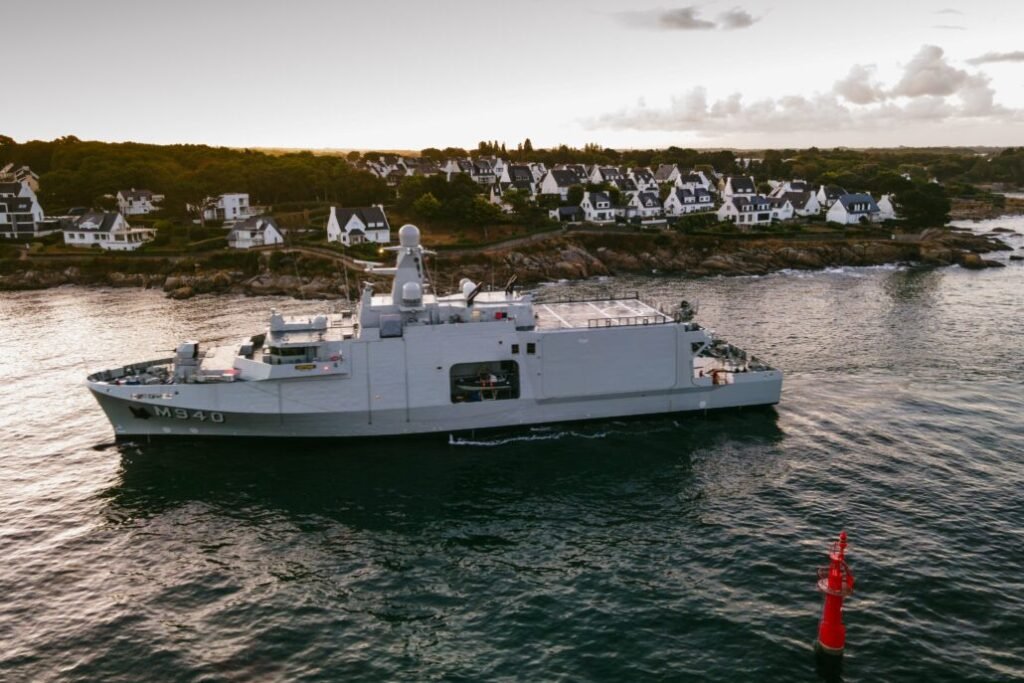
Zeebrugge, 3 November 2025. The Belgian Navy has welcomed the arrival of the M940 Oostende, a state-of-the-art mine countermeasures vessel (MCMV), at Zeebrugge Naval Base. This marks a historic milestone for both Belgium and the Netherlands within the replacement Mine Counter Measures (rMCM) programme, which envisages the delivery of six vessels to each navy.
Oostende is the first ship designed under the stand-off concept, integrating an advanced “toolbox” of autonomous surface, underwater, and aerial drones. This system enables the detection, classification, and neutralisation of naval mines from a safe distance, enhancing crew safety while making mine hunting operations faster and more precise.
Currently, the ship is moored under a commercial flag, with the official handover to the Belgian Ministry of Defence scheduled for 7 November 2025. Until then, Oostende remains property of the Belgium Naval & Robotics consortium.
Next-Generation Mine Countermeasures
Vice Admiral Tanguy Botman, Commander of the Belgian Navy, emphasised that Oostende’s arrival represents the first step towards next-generation mine warfare: “Safer, more efficient, and fully adapted to the maritime challenges of tomorrow.”
Crew training has already begun, focusing initially on safe navigation under normal conditions, without using the advanced toolbox. Subsequent exercises will integrate the use of drones. At the same time, specialised technicians are being trained in the factory to optimise the toolbox once the modules are formally handed over. The first delivery of autonomous systems is scheduled for end of November 2025.
Rear Admiral Kristof Van Belleghem, Chief of Staff of the Belgian Navy, noted that naval mines remain a real threat to shipping, fishing, and the environment: “If ports are closed due to mines, the economy grinds to a halt. Goods, energy, and supply chains are disrupted. The Navy ensures that trade and security continue.”
International Cooperation and Technological Innovation
The rMCM programme, awarded in 2019 to Belgium Naval & Robotics (Naval Group and Exail), will provide twelve mine countermeasures vessels and around 100 drones to the Belgian and Dutch navies. Naval Group is responsible for ship design, integration, and testing of the mission system, while Exail provides the unmanned and robotic systems.
The vessels measure 82.6 metres in length, 17 metres in beam, and displace 2,800 tonnes. They have a maximum speed of 15.3 knots and a range exceeding 3,500 nautical miles. Crew complement is 63 personnel, including a core crew of 33. Systems include the Naval Group Polaris combat system, the Exail UMISOFT drone management system, as well as multiple unmanned surface vehicles (USVs), autonomous underwater vehicles (AUVs), towed sonars, mine identification and disposal systems (MIDS), and an unmanned aerial system (Skeldar V200).
Naval Group CEO Pierre Eric Pommellet commented: “We are developing a game-changing defence solution to serve Belgian and Dutch sovereignty.” Belgian Minister of Defence Ludivine Dedonder added: “Our operational concept is a world first, demonstrating that cooperation, solidarity, and innovation are key to our common security.”
Progress of the rMCM Programme
Within the programme, the Vlissingen, the second vessel intended for the Royal Netherlands Navy, began its first sea trials on 27 March 2025 from Concarneau, France, to validate performance before delivery at the end of 2025. The Tournai, third vessel and second for Belgium, is scheduled for initial sea trials at the end of summer 2025. The Scheveningen, second Dutch vessel, was launched in November 2024. All twelve vessels are expected to be delivered by 2030.
Belgium’s Industrial Contribution
The programme strengthens Naval Group and Exail’s strategic presence in Belgium. The toolbox systems will be developed, produced, and assembled in Belgium, maximising domestic industrial value. Additionally, the MCM Lab and Cyber Lab in Belgium conduct R&D projects with institutional, industrial, and academic partners to advance mine countermeasures and cybersecurity innovation.
Looking Ahead
Oostende represents a paradigm shift in mine warfare for the Belgian and Dutch navies. The stand-off operational approach enhances the safety of both the vessel and crew while significantly increasing the speed of mine clearance. This vessel symbolizes European maritime security and international cooperation, playing a critical role in the years ahead.