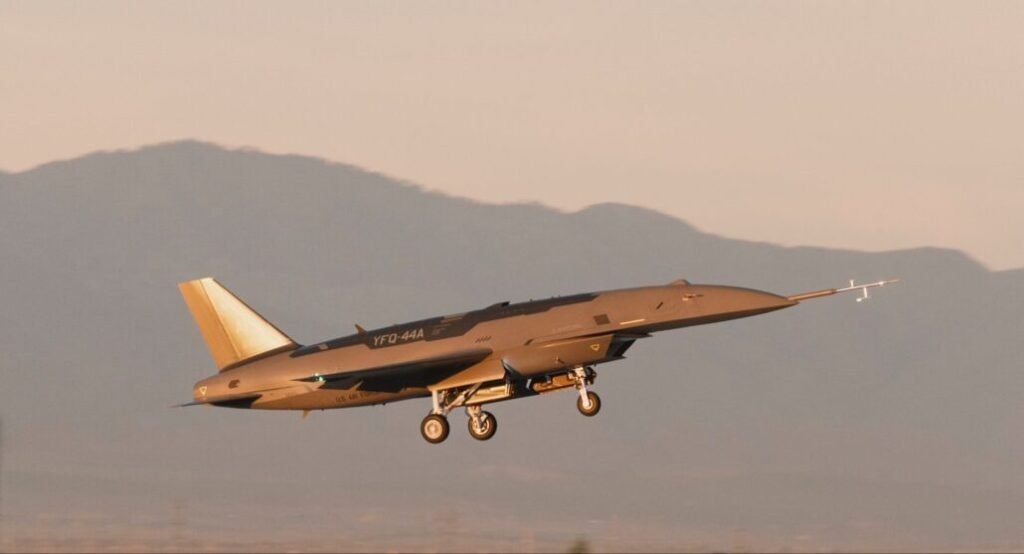
On 31 October 2025, the YFQ‑44A Collaborative Combat Aircraft (CCA), developed by Anduril Industries, completed its first test flight for the United States Air Force. Part of the Collaborative Combat Aircraft (CCA) program, the semi‑autonomous aircraft marks a significant step in a new phase of air‑superiority concepts. The YFQ‑44A reached test flight just 556 days after its design — one of the fastest clean‑sheet fighter programs in recent years.
Dr. Troy E. Meink, the 27th Secretary of the Air Force, said in a post on his official X account that the milestone “shows how competition drives innovation & accelerates delivery,” and emphasized the flight provides critical data to reduce program risk and deliver operational capability to the field on schedule. The program aims to preserve U.S. competitive advantage against rapidly modernizing air forces.
According to Anduril’s press release, the YFQ‑44A’s flight was conducted in a fully semi‑autonomous mode: rather than being flown by direct pilot input, the aircraft executed a mission plan via its software, managed flight control and throttle, and returned to land. The test is a critical verification of manned‑unmanned teaming concepts and Manned‑Unmanned Teaming (MUM‑T) tactics.
The YFQ‑44A is designed to operate both alongside crewed fighters such as the F‑22 and independently. Its low radar cross‑section, integrated weapons systems, high maneuverability, and a projected combat radius of 700+ nautical miles position it for future air‑superiority roles. Anduril is preparing for production using the ArsenalOS software backbone and the 5‑million‑square‑foot Arsenal‑1 facility in Columbus, Ohio; the company has stated a target unit cost of $25–30 million to enable the program’s “affordable mass” strategy.
As part of the Collaborative Combat Aircraft (CCA) program, the YFQ‑44A competes with General Atomics’ YFQ‑42A, which completed its test flight in August 2025. Anduril’s approach prioritizes a software‑first, rapid autonomy‑validation strategy, while the YFQ‑42A follows a more traditional, phased integration approach backed by General Atomics’ UAS experience. The U.S. Air Force plans a production decision in FY26; the service may select one or both platforms for production.
The program’s strategic goal is to field an “affordable mass” fleet to sustain U.S. air superiority. Planners aim for a force of 1,000+ CCAs to operate alongside NGAD F‑47 and F‑35 aircraft, delivering force multiplication and complicating adversary A2/AD defenses.
Anduril’s CEO said, “The YFQ‑44A is more than a flying machine — it is an autonomous, combat‑ready aircraft.” CCA program testing is intended to mature both technical capabilities and operational concepts in parallel, enabling the rapid delivery of validated capability to the field. This first flight is recorded as a milestone in the shift toward human‑machine teaming for future U.S. air superiority.