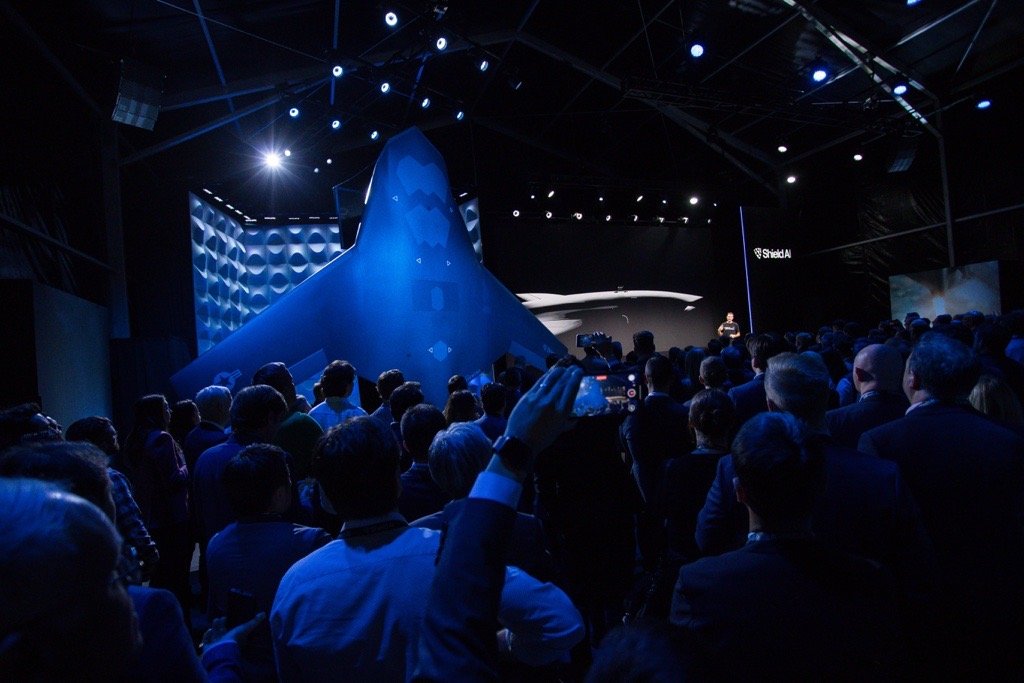
Making a rapid entry into the world of defense technologies, Silicon Valley-based deep tech firm Shield AI formally unveiled the concept for its AI-piloted vertical takeoff and landing (VTOL) fighter jet, the X-BAT, designed for contested environments. The X-BAT took center stage at a high-level event held in Washington, D.C. on Tuesday, October 21, 2025, with the official press release following on October 22, 2025. This “curtain-raising” event hosted a top-tier audience of military leaders, elected officials, and industry partners.
During the unveiling, a structurally and aerodynamically advanced scale model of the unmanned aerial vehicle (UAV) was showcased, rather than a full production model. Shield AI Co-founder, President, and former Navy SEAL commando Brandon Tseng highlighted the strategic significance of the system, stating, “Airpower without runways is truly the holy grail of deterrence,” adding that it grants forces persistence, reach, and survivability, and “buys diplomacy another day”. Tseng further noted that the VTOL’s capability creates an “infinite number of dilemmas” for the adversary. The X-BAT’s development process prior to the launch had spanned approximately 18 months, during which wind tunnel, pole, and engine testing were completed.
Classified under Pentagon terminology as a Group 5 Unmanned System—the largest and highest-performing class traditionally reserved for manned fighter jets—the X-BAT is designed as a direct answer to the increasing vulnerability of traditional air force infrastructure against modern A2/AD (Anti-Access/Area Denial) threats. The X-BAT is the only platform in its class that combines VTOL capability with long range exceeding 2,000 nautical miles (>3,700 km) and multirole dominance.
X-BAT, with its runway-independent flexibility, can be launched and recovered from ships, remote islands, or austere forward bases, thereby eliminating dependency on traditional infrastructure. This feature aligns perfectly with mobility-centric warfighting concepts utilized by the U.S. Navy and Marine Corps (USMC), such as Distributed Maritime Operations (DMO) and Expeditionary Advanced Base Operations (EABO).
At the heart of the aircraft lies Hivemind, Shield AI’s combat-proven proprietary software, which serves as the AI Pilot. X-BAT is offered as an integrated system with this AI, but the software’s open architecture design ensures “plug-and-play” compatibility with current and future Navy and Air Force concepts, and can even support autonomy software from third-party vendors.
Hivemind is engineered to provide resilient execution in environments that are denied, degraded, or disconnected (D3); meaning it can complete missions with no GNSS (GPS), no comms, and no human input required. Armor Harris, Shield AI’s Senior Vice President of Aircraft, stated that the X-BAT has the ability to “organically close its own kill chains without reliance on third-party assets”.
This autonomy allows the X-BAT to dynamically team with manned aircraft as a digital wingman, or function as an autonomous asset within a team of N-number of X-BATs controlled by a single commander. Hivemind enables the execution of tactical decisions at “machine speed,” completing the observe, orient, decide, and act (OODA) loop in milliseconds. The reliability of the autonomy is reinforced by its operational validation since 2019 across over fifteen platforms, and its contribution to the landmark X-62A VISTA flight tests, where an F-16 test aircraft was autonomously flown against a manned F-16 in a within-visual-range dogfight scenario. This confirmed the AI’s ability to safely and effectively control complex air combat maneuvers through reinforcement learning.
In terms of technical specifications, the X-BAT features a distinctive ‘cranked kite’ planform with sleek surfaces optimized for low radar observability, boasting a 39-foot wingspan and 26-foot length. Logistics are simplified by its ability to be stored in an area measuring 40 ft x 14 ft x 6 ft. Its performance is fighter-class, designed to withstand a >4g maneuver load factor.
The platform is engineered around an F-16 Fighting Falcon-class jet engine featuring an afterburner and a thrust vectoring nozzle. Shield AI has been consulting with Pratt & Whitney and General Electric—manufacturers of the F-16’s F100 and F110 engines, respectively—regarding the propulsion system. Armor Harris indicated that the strategy involves refurbishing and utilizing “a large number of old engines in the fleet” to circumvent the long build times of new engines.
The aircraft’s maximum range exceeds 2,000 nautical miles (>3,700 km) with a full mission payload, and its maximum ceiling is over 50,000 feet. The X-BAT is multirole capable, executing strike, counter-air, electronic warfare (EW), and intelligence, surveillance, and reconnaissance (ISR) missions.
Its weapon carriage capability includes internal weapons bays for signature management and external hardpoints for large strike weapons. This allows the platform to carry air-to-air missiles such as the AIM-120 AMRAAM or AIM-174B. The sensor suite provides the full spectrum of active and passive air-to-air, air-to-ground, and air-to-surface modes.
Furthermore, its compact footprint offers a 3:1 Expeditionary Footprint advantage, meaning three X-BATs can fit within the deck space of one legacy fighter or helicopter. This scalability significantly multiplies sortie generation rates. Shield AI stated that the X-BAT is on track to be produced for approximately $27 million per unit.
This price point is a small fraction of the cost of 5th generation fighters like the F-35 (which costs over $100 million each), providing a compelling Cost-to-Effect Ratio that permits deployment at scale. Shield AI plans to conduct its first VTOL flights in the Fall of 2026 and aims for full mission capability (FMC) and readiness for production by 2028.
The company indicated that other production partners, who will assist in constructing the airframe and engine system, will be announced “in the coming weeks” following the launch. Armor Harris emphasized that the X-BAT represents a revolution in airpower because it combines “VTOL, range, multirole capability, and autonomy”.
This design is informed by Harris’s previous senior roles at SpaceX, including work on the vertical landing capability of the Falcon 9. The X-BAT is competing against established contractors such as Anduril, General Atomics, and Kratos as a potential option for the U.S. Air Force and Navy’s ongoing Collaborative Combat Aircraft (CCA) programs.