The war in Ukraine continues to generate a relentless cycle of adaptation across every domain of conflict, and the Black Sea remains one of the most dynamic arenas in this struggle. Within this shifting maritime environment, recent incidents involving Russian-affiliated commercial vessels reveal a clear split in Ukrainian behavior. Some attacks are openly confirmed by Kyiv, while a single, contentious event has been met with an immediate and categorical denial.
Ukraine’s established maritime strategy, carried out primarily by the Security Service of Ukraine, has focused on weakening Russia’s logistical and economic foundations. This approach was demonstrated in late November 2025 through successful drone attacks on the sanctioned oil tankers Kairos and Virat. These vessels were part of Russia’s extensive shadow fleet used to bypass international oil sanctions. Both tankers were reportedly struck by explosive naval drones with large payloads. Ukrainian officials stated that the ships suffered critical damage and were effectively removed from service, highlighting Kyiv’s intent to disrupt Russia’s oil transport network and limit revenue flowing into the war effort.
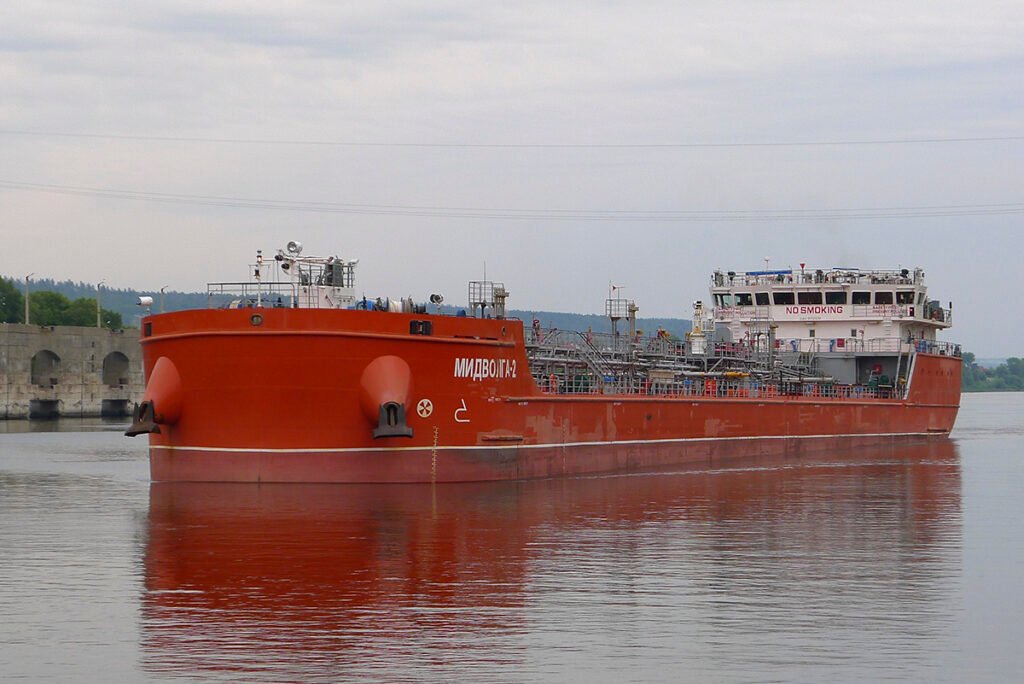
The clarity of this pattern changed abruptly with the reported strike on the Russian-flagged tanker Midvolga-2 on December 2. Russian state media claimed that the ship was hit by a Ukrainian drone about eighty nautical miles off Turkey’s northern coast, inside Turkey’s Exclusive Economic Zone. Unlike the previously targeted tankers associated with sanction evasion, the Midvolga-2 was transporting sunflower oil from Russia to Georgia, which placed it outside the category of shadow fleet operations that Ukraine has repeatedly targeted.
Physical evidence also pointed to an unusual profile. The tanker suffered limited and mostly superficial damage, such as smoke traces, broken windows, shrapnel marks near the bridge and a partial ceiling collapse inside the control room. The engines remained operational and the ship continued toward Sinop without requesting assistance. The absence of severe structural damage and the presence of debris on the deck, including rotor parts and cables along with a wheel-like component, suggested an attack by a long-range aerial drone rather than a heavy explosive naval drone.
Ukrainian officials responded with an immediate and categorical denial. Foreign Ministry spokesperson Heorhii Tykhyi rejected the accusations as Russian propaganda and insisted that Ukraine had no involvement. He also questioned the reported route of the vessel. Since the ship was carrying sunflower oil from Russia to Georgia, he argued that its path through the Turkish Exclusive Economic Zone made no sense and raised the possibility that Russia staged the incident.
These developments are taking place as the southern Black Sea experiences repeated kinetic actions inside Turkey’s Exclusive Economic Zone. This pattern brings growing diplomatic risks for Kyiv. Turkey, which controls the Bosphorus and maintains complex and carefully balanced relations with both Russia and Ukraine, reacted strongly to the recent escalation. Following the confirmed strikes on Kairos and Virat, the Turkish Foreign Ministry condemned the attacks for endangering navigation, human life, property and the marine environment. President Recep Tayyip Erdoğan reinforced this warning and described the drone incidents as a worrying escalation that threatens the safety of navigation inside the Turkish zone.
Whether the Midvolga-2 incident was the result of a Ukrainian attack or a Russian deception effort, it highlights a worsening security picture in the Black Sea. Actions that intersect with the jurisdictional waters of a regional power like Turkey deepen the strategic complexity of the conflict and raise the potential consequences for all actors operating in these contested waters.