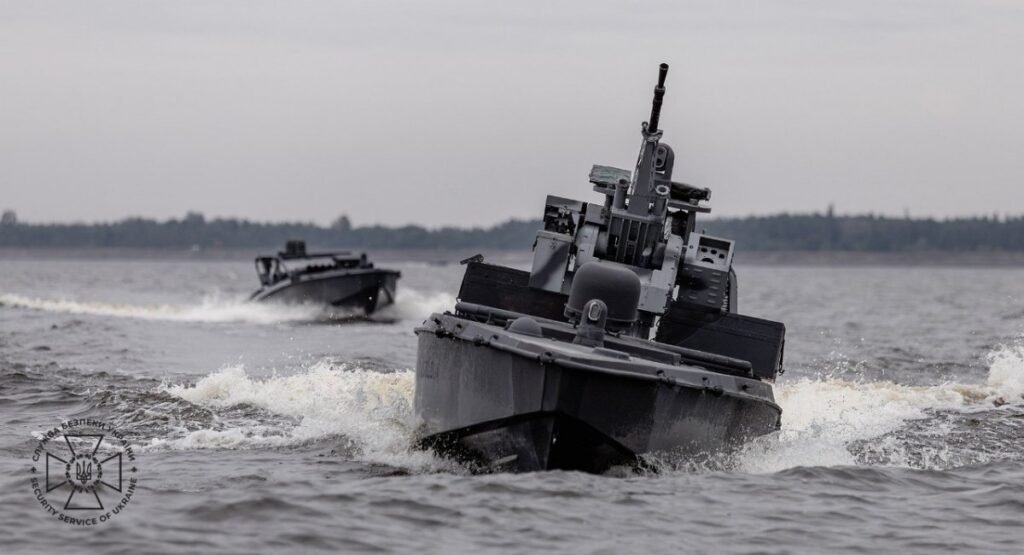
On 28 November 2025, it emerged that the oil tankers KAIROS and VIRAT, both linked to shadow-fleet operations, had been struck by Sea Baby naval unmanned aerial vehicles (UAVs) developed by the Security Service of Ukraine (SBU). These simultaneous attacks signaled a strategic shift in the Black Sea, targeting not only Russia’s military assets but also the Kremlin’s sanction-evading oil trade, a key economic lifeline. SBU sources claimed that the upgraded Sea Baby drones successfully hit the vessels, while footage of the strikes was shared on Telegram by Ukrainian media figure Serhiy Sternenko. The operation effectively turned sanctions-evading oil transport into a legitimate military target at a time when international economic restrictions had proven insufficient.
The attack targeted two key vessels at the core of Russia’s shadow-fleet network, which plays a central role in financing the war effort. KAIROS, a 149,989-DWT Suezmax tanker built in 2002 and sailing under the Gambian flag, had been sanctioned by the EU, the UK and Switzerland. At the time of the strike, it was in ballast and returning to Novorossiysk after delivering Urals crude to India. About an hour later, the second vessel—VIRAT, a 115,643-DWT Aframax tanker built in 2018—was hit. VIRAT appears on sanctions lists in the U.S., EU, UK and Canada, is managed through Hong Kong-based corporate structures, and exhibits the common traits of shadow-fleet operations, including frequent AIS deactivation to evade oversight.
The operation was not limited to the tankers themselves. Shortly after KAIROS and VIRAT were struck, reports indicated that the Caspian Pipeline Consortium (CPC) marine terminal near Novorossiysk had also been hit. The attack allegedly disabled one of the terminal’s mooring components, forcing a temporary halt to loading operations and the withdrawal of tankers from the area. This coordinated action was viewed as part of a broader campaign designed to disrupt both the transportation assets and the critical loading infrastructure that support Russia’s oil export system.
The success of these long-range, coordinated strikes highlighted the continued evolution of the Sea Baby platform. The latest version, unveiled by the SBU in late 2025, is reported to have an extended range exceeding 1,500 kilometers, effectively turning most of the Black Sea—including approaches to the Bosphorus—into a potential risk zone. Enhancements in explosive payload capacity and modular architecture have transformed the Sea Baby from a single-use strike vehicle into a multi-role naval platform capable of carrying remotely operated weapon systems.
Turkish authorities responded rapidly, deploying rescue teams, tugboats and the emergency response vessel NENE HATUN to the scene. All 45 crew members aboard the two tankers were safely evacuated, and no casualties were reported. Because the vessels were in ballast at the time, the explosions did not trigger a major environmental disaster, and no oil pollution was detected. Officials emphasized that the incidents underscored the increasing risks to maritime traffic and heightened concerns surrounding shadow-fleet activity in the Black Sea.
The incident also raised complex questions under international maritime law. The SBU’s framing of sanction-evading oil shipments as direct contributors to Russia’s war economy fueled debate over whether such vessels could be considered “contraband carriers” and therefore lawful military targets. Meanwhile, the shadow fleet’s operation outside the International Group of P&I Clubs—with minimal insurance coverage—continues to pose serious environmental and economic risks for coastal states such as Türkiye in the event of a spill or casualty. These attacks are expected to increase war-risk premiums for all commercial traffic in the Black Sea, amplifying the broader economic ripple effects of regional instability.