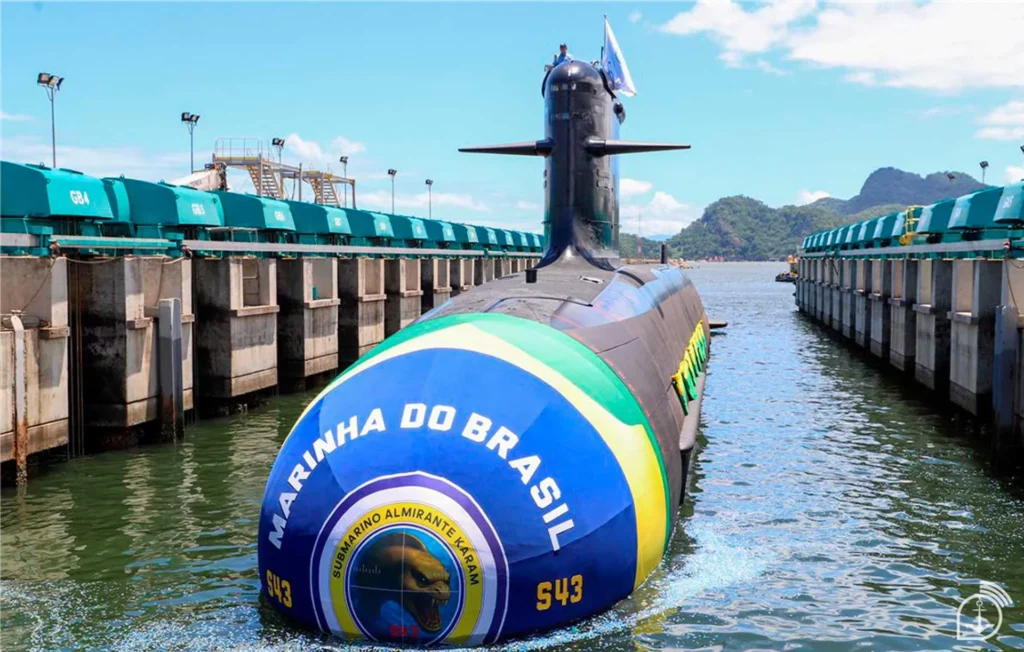
On November 26, 2025, a landmark day for the Brazilian Navy, the third conventional submarine built under the Submarine Development Program (PROSUB), S42 Tonelero, was officially commissioned in a ceremony. The event, held at the Itaguaí Naval Construction Complex (ICN) near Rio de Janeiro, also marked the launching and christening of the fourth and final conventional submarine, S43 Almirante Karam. This simultaneous achievement demonstrates Brazil’s determined progress in modernizing its submarine force and reinforcing sovereignty over its vast maritime domain, known as the “Blue Amazon.”
S42 Tonelero: From Construction to Operational Capability
The third vessel of the Riachuelo class, S42 Tonelero, is named after a significant operation of the Brazilian Imperial Navy during the Platine War. Its commissioning signifies the successful completion of an extensive and demanding testing process. Following its launch in March 2024, Tonelero completed initial sea trials in early 2025, proving it meets the operational requirements of the Navy.
During the ceremony, the personnel of Itaguaí Construções Navais (ICN), responsible for the submarine’s construction and initial validation stages, formally handed over the vessel to the permanent operational crew assigned to the Submarine Force (Força de Submarinos – ForSub). This transfer symbolizes Tonelero’s full operational capability as a modern combat platform within the Brazilian Navy’s inventory.
With Tonelero joining the fleet, the Brazilian Navy now operates three modern Riachuelo-class submarines: S40 Riachuelo (commissioned September 2022), S41 Humaitá (January 2024), and S42 Tonelero (November 2025). This trio significantly enhances Brazil’s submarine deterrence capacity in the Southern Hemisphere.
Completion of the Fourth Vessel: Almirante Karam
Simultaneously, the fourth and final conventional unit of the series, S43 Almirante Karam, was launched and christened. Named after former Admiral Alfredo Karam, the submarine’s christening was sponsored by Cármen Lúcia Antunes Rocha.
The launch signifies the completion of the hull construction phase and the submarine’s first contact with water. Following this, S43 will undergo port and sea trials to rigorously test the integrated functionality of its sensors, navigation, communication, and weapons systems. According to the official schedule, S43 Almirante Karam is expected to be delivered and commissioned into the Submarine Force in 2026.
Strategic Importance of PROSUB and Industrial Infrastructure
This dual milestone confirms the success of Brazil’s Submarine Development Program (PROSUB), launched in 2008 with an estimated cost of R$31.85 billion. PROSUB is a strategic national project focused not only on military procurement but also on developing the country’s defense industry capabilities and technological independence.
The program’s primary goal is to protect Brazil’s 4.5 million square kilometers of maritime territory, the “Blue Amazon,” which is rich in biodiversity and strategically important pre-salt oil reserves. Submarines offer a unique tool for defending this vast area, providing extended endurance, stealth, and deterrence capabilities.
Through comprehensive technology transfer agreements with French Naval Group (formerly DCNS), Brazil gained expertise in modern submarine hull design and construction. This technology transfer also included the establishment of extensive industrial infrastructure in Itaguaí, featuring shipbuilding and maintenance facilities and a naval base.
Operational Capabilities and Technological Independence
Riachuelo-class submarines are Brazilian-adapted versions of the French Scorpène-class design. Displacing approximately 1,900 tons on the surface and measuring 70.62 meters in length, these platforms offer significantly greater endurance than the older Tupi-class submarines. Mission durations have increased from 45 to 70 days, enabling longer and more effective patrols in the Blue Amazon.
The class’s weapon systems are notable. Equipped with six standard 533 mm torpedo tubes, the submarines can fire advanced French F21 heavyweight torpedoes. Critically, they also support SM-39 Exocet anti-ship missiles launched from underwater, transforming the submarine from a purely defensive asset into a strategic strike platform.
Additionally, the Brazilian Navy has nationalized critical systems such as the Command and Control System (CMS) software, ensuring operational independence. This technological sovereignty is crucial for the country’s future military projects.
Nuclear Future: SN-BR Álvaro Alberto
The successful commissioning of the conventional fleet lays the foundation for the ultimate goal of PROSUB: the construction of the nuclear-powered attack submarine SN-BR Álvaro Alberto (SN10). Officially designated as the fifth unit of the Riachuelo class, Álvaro Alberto will leverage hull construction expertise gained from conventional submarines.
Construction officially began with the first steel cut in June 2024. The submarine is expected to be launched in 2029, followed by three to four years of trials, with commissioning projected between 2032 and 2034. While the nuclear propulsion system is a national effort, the Brazilian Navy has signed additional contracts with French Naval Group for reactor integration and technical support.
The commissioning of Tonelero and the launch of Almirante Karam not only complete Brazil’s conventional submarine capability but also herald a larger strategic objective: joining the ranks of the few global powers capable of operating nuclear submarines. These achievements strengthen Brazil’s position as a regional naval power while highlighting the maturity of its domestic defense industry.