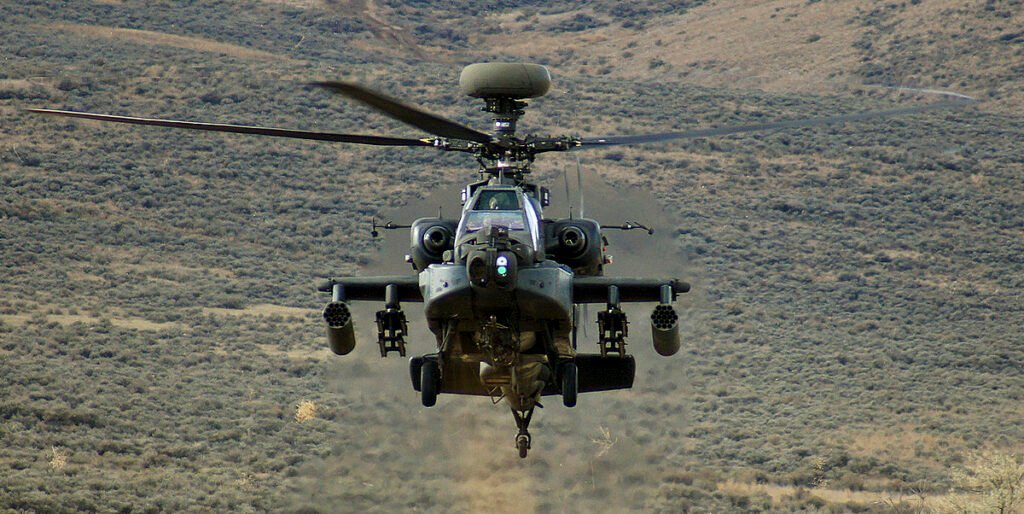
MESA, Arizona – On November 26, 2025, the U.S. Army Contracting Command executed a pivotal Foreign Military Sales (FMS) contract with The Boeing Co., valued at nearly $4.7 billion ($4,685,369,804). This firm-fixed-price (FFP) award guarantees the production of the advanced AH-64E Apache Guardian attack helicopters, along with essential Longbow crew trainers, spares, and associated components.
The contract is structured as a multi-national production effort, funded collectively under the FMS program by three critical U.S. partner nations: Poland, Egypt, and Kuwait. This arrangement is strategically vital for all participants; for the U.S. industrial base, the volume of these combined international orders stabilizes the Apache production line in Mesa, Arizona, ensuring manufacturing continues well into the next decade, with an estimated completion date of May 30, 2032. Initial FMS funding totaling over $2.29 billion was obligated at the time of the award to commence production activities across the three nations’ requirements.
Poland: A New Pillar for NATO’s Eastern Flank
The centerpiece of this massive production contract is Poland, whose order represents the single largest international purchase in the Apache program’s history. The Polish Armed Forces are acquiring a formidable fleet of 96 AH-64E Guardian helicopters as the core element of the nation’s Kruk (Raven) program, designed to replace its aging, Soviet-era Mi-24 platforms. This acquisition directly addresses the heightened security environment on NATO’s Eastern Flank, particularly along borders near Belarus and the Russian exclave of Kaliningrad, aligning with Poland’s commitment to allocate the highest proportion of GDP to defense within NATO.
While the production contract covers the manufacturing of the airframes and trainers, Poland’s total commitment under the approved FMS Letter of Offer and Acceptance (LOA) for the full operational ecosystem is estimated to be approximately $10 billion to $12 billion. This comprehensive package includes advanced weaponry, such as AGM-114R2 Hellfire missiles, AGM-179A Joint Air-to-Ground Missiles (JAGM), and AN/APG-78 Longbow Fire Control Radars, alongside extensive pilot and maintenance training.
In anticipation of the first AH-64E deliveries, expected to begin in 2028, Poland is already accelerating readiness. The Polish Ministry of National Defence is currently leasing eight AH-64D Apaches from the U.S. Army to train personnel and integrate the platform’s tactics and command structures, ensuring rapid operational capability once the new fleet arrives. Furthermore, Boeing has committed to industrial offset agreements to establish local maintenance, repair, and overhaul (MRO) capabilities within Poland, fostering long-term sustainment autonomy.
Middle East Partners: Fleet Modernization for Regional Security
Crucially, the $4.7 billion production award is sustained by the modernization efforts of two key partners in the Middle East: Egypt and Kuwait. Their pooled FMS funds demonstrate a continuous, strong demand for the AH-64E Guardian to bolster their respective regional defense postures.
Egypt, a long-time Apache operator, is committed to upgrading and expanding its fleet. The country had previously received approval for the sale of ten (10) AH-64E Apache helicopters and associated support for an estimated $1.0 billion, with funding for this production phase secured under the joint contract.
Kuwait is similarly leveraging the FMS process to enhance its attack aviation capabilities. As part of a larger approved defense modernization package potentially valued at up to $4 billion, Kuwait’s contribution to this contract supports the acquisition of new AH-64E gunships and/or the upgrade of its existing AH-64D models to the latest E-model standard.
For both nations, the acquisition of the AH-64E—which features digital architecture, enhanced engines, and advanced sensor fusion—provides essential capabilities for counter-terrorism, border security, and maintaining interoperability with U.S. forces in the region.
Strategic Outlook
This multi-national $4.7 billion production contract underscores the enduring global demand for the AH-64E Apache Guardian, which Boeing projects will serve the U.S. Army and its allies well into the 2060s. By combining the needs of Poland’s strategic shift on the European continent with the modernization requirements of Egypt and Kuwait, the U.S. Army ensures the sustained industrial viability of a critical platform, promoting standardization and interoperability across vital alliance structures globally. This collective investment ensures that the AH-64E remains the benchmark for sophisticated attack aviation worldwide.