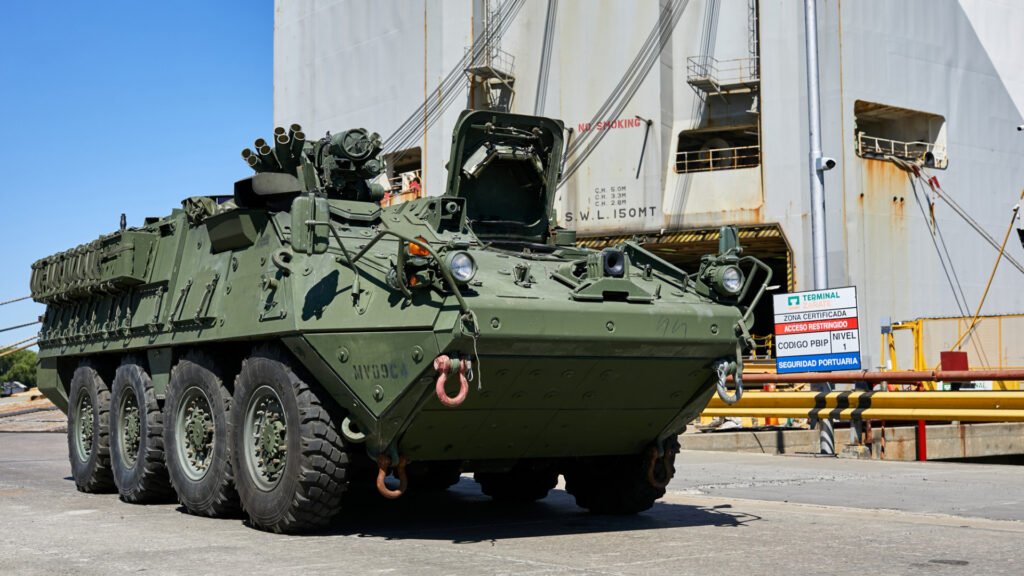
The Argentine Army has taken delivery of its first M1126 Stryker Infantry Carrier Vehicles following their verified arrival at the Port of Zárate on November 25, 2025. The transfer concludes a multi-year Foreign Military Sales process that began with a 2020 U.S. congressional notification and only matured into a formal Letter of Offer and Acceptance in mid-2025. Their arrival grants Argentina an immediate qualitative upgrade in protected mobility and signals the tangible implementation of a long-delayed modernization priority.
The initial batch consists of the M1126 Infantry Carrier Vehicle configuration designated locally as the VCBR. This variant provides protected transport for an infantry squad and arrives equipped with U.S.-standard digital architecture and a remote weapon station configured for the M2 heavy machine gun or Mk 19 grenade launcher. The selection of the personnel-carrier configuration confirms that the Argentine Army is prioritizing mobility, C4I integration, and rapid troop deployment capabilities. These requirements align directly with the mission set assigned to the Rapid Deployment Force which will be the primary user of the new platforms.
The vehicles were unloaded at Zárate following significant logistical preparation that included preplanned de-processing work supported by General Dynamics specialists. This support is part of the broader FMS package which also mandates contractor presence to complete post-shipment technical tasks, conduct inspections, and ensure the vehicles are ready for operational integration. The Argentine Army’s first cadre of operators and maintainers had already completed theoretical and practical instruction in the United States earlier in November enabling the Army to begin domestic training cycles immediately after delivery.
The Stryker acquisition program was initially valued at one hundred million dollars and includes a full suite of communications, vision enhancement, and intercom systems. The incorporation of SINCGARS radios and Driver’s Vision Enhancers offers a generational improvement over Argentina’s predominantly analog armored fleet. The package also covers spare parts, technical manuals, specialized tools, and Field Service Representatives who will remain in Argentina for initial sustainment. The absence of industrial offsets meanwhile underscores that the program is structured around rapid capability delivery rather than domestic production or technology transfer.
The protracted delay between the 2020 notification and the 2025 LOA signature reflected economic constraints and shifting political priorities. The current administration’s strong alignment with Washington removed the final obstacles and enabled the long-awaited agreement to be signed during a July 2025 visit to the U.S. capital. The timing coincided with other major U.S. defense acquisitions including the planned procurement of F-16 fighters reinforcing a broader strategic pivot toward Western suppliers and standards.
Operationally, the Stryker fills substantial capability gaps created by decades of underinvestment. Legacy armored personnel carriers such as the M113 and TAM VCTP lack the protection and digital systems required for modern operations. The Stryker’s road-optimized mobility wide operational reach and enhanced protection levels provide the Argentine Army with a platform tailored for stability missions disaster response and peacekeeping operations. This focus on mobility rather than heavy firepower aligns with the U.S. assessment that the acquisition will not alter the regional military balance.
Regionally and geopolitically, the delivery reflects a renewed emphasis on U.S.-Argentine defense cooperation. Analysts have noted that the finalization of long-pending agreements occurred as China increased its outreach to Buenos Aires in both economic and defense sectors. In this context the Stryker transfer represents a calculated reinforcement of Washington’s partnership with a Major Non-NATO Ally. The adoption of a platform that relies on U.S. supply chains training methodologies and C4I architecture establishes long-term interoperability and creates durable ties between the two militaries.
The entry of the Stryker into Argentine service marks a decisive moment in the country’s modernization agenda. Achieving full operational capability will require additional procurement phases sustained funding and expansion of maintenance infrastructure to reduce reliance on contractor support. The initial delivery nevertheless provides the Rapid Deployment Force with a modern mobility asset and underscores Argentina’s renewed commitment to aligning its defense posture with U.S. strategic standards. The decisions taken over the coming years regarding fleet expansion and sustainment will determine the depth and durability of this new phase in bilateral defense cooperation.