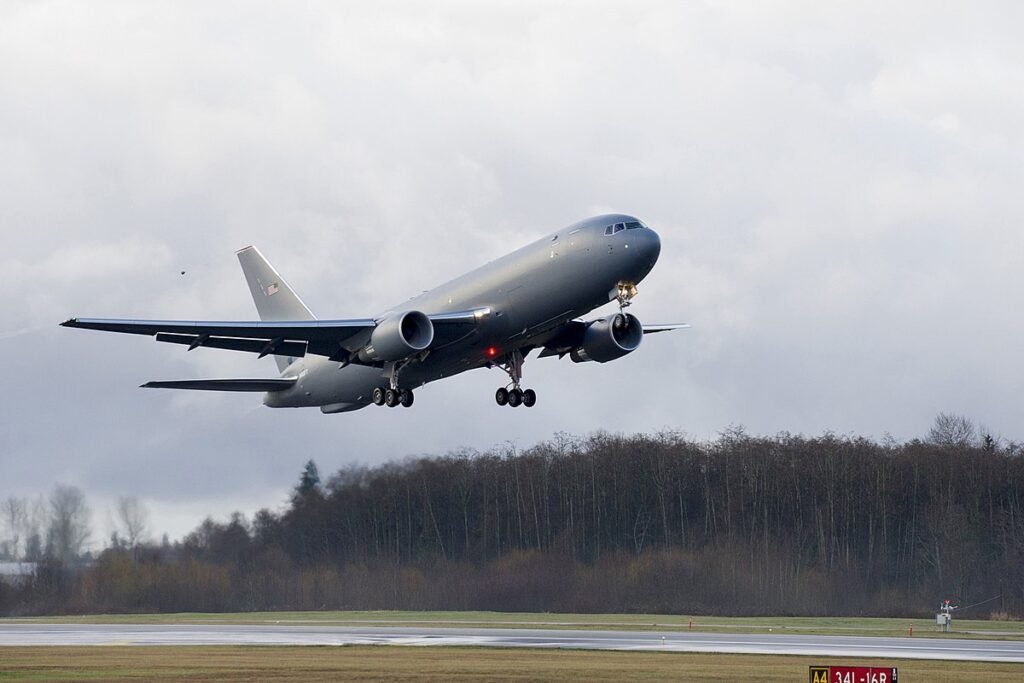
WASHINGTON – Boeing has secured the Lot 12 production contract from the U.S. Air Force (USAF) for 15 additional KC-46A Pegasus aerial refueling tankers, valued at $2.47 billion. This agreement provides essential continuity for the platform’s production line, with Jake Kwasnik, vice president and KC-46 program manager, noting that the contract helps ensure stability, particularly for the long-lead supply chain components. Work on this particular lot is anticipated to be completed by June 30, 2029.
The latest procurement brings the total inventory of KC-46A multi-mission aerial refuelers either on contract or already in service worldwide to 183 aircraft. This global figure includes 98 aircraft already delivered to the U.S. Air Force, alongside international deliveries of six aircraft to the Japan Air Self-Defense Force and four contracted for the Israel Air Force. The tanker continues to generate steady international interest as allied nations seek modernization solutions offering improved connectivity and survivability over legacy platforms.
Analysis of the contract value confirms an accelerating unit cost trajectory for the Pegasus platform. The $2.47 billion Lot 12 award for 15 aircraft is a measurable increase compared to the previous Lot 11 contract, which secured 15 tankers for $2.38 billion in November 2024. Although the annual procurement lots are structured with a “Not to Exceed” (NTE) unit price, the contracts include an Economic Price Adjustment (EPA) clause, suggesting that macroeconomic inflation is actively driving up the material and labor costs associated with manufacturing the aircraft.
Despite these procurement cost pressures and ongoing technical issues, the KC-46A fleet continues to demonstrate high operational utility and rapid integration into the global mobility force. The U.S. fleet has now surpassed 150,000 flight hours through continuous operational sorties and global missions. This operational maturity was further validated by a historic seven-month contingency operation in 2024/2025, which constituted the platform’s largest and longest deployment to date and achieved the highest sortie generation rate in theater.
However, the high operational tempo runs concurrent with measured declines in core readiness metrics. The KC-46A program is currently not meeting many of its mandated suitability standards, with the Mission-Capable (MC) rate declining from 65% in 2023 to 61% in 2024, falling significantly short of the required 90% operational threshold. This decline in readiness is largely attributed to component shortages and systemic logistics issues that are placing stress on the sustainment pipeline.
The core capability gap remains concentrated on two Category 1 deficiencies, the most significant being the Remote Vision System (RVS). The original RVS suffers from glare and display issues that can distort the image for boom operators, posing a risk of damage to receiver aircraft. The required fix, RVS 2.0, which uses 4K cameras and LiDAR technology, has faced repeated delays and is now projected for fielding no earlier than Summer 2027, well beyond its original target of late 2023. The excessive stiffness of the refueling boom also continues to limit operations and prevents the KC-46A from safely connecting with lighter receiver aircraft, including the A-10 Warthog.
This Lot 12 acquisition reinforces the Air Force’s strategic decision to rely exclusively on the Pegasus to bridge the capacity gap until the Next Generation Air-Refueling System (NGAS) is deployed. The service has abandoned the competitive KC-Y “Bridge Tanker” program in favor of a sole-source 75-aircraft KC-46A Production Extension Program (PEP) to mitigate the schedule risks associated with the KC-135 retirement, which begins in 2027. The USAF justified this approach by determining that selecting another vendor would result in an “unacceptable delay of up to eight years” in meeting urgent mobility requirements, cementing the KC-46A as the necessary backbone of the permissive-environment air mobility fleet until the NGAS achieves its anticipated Initial Operational Capability around 2040.