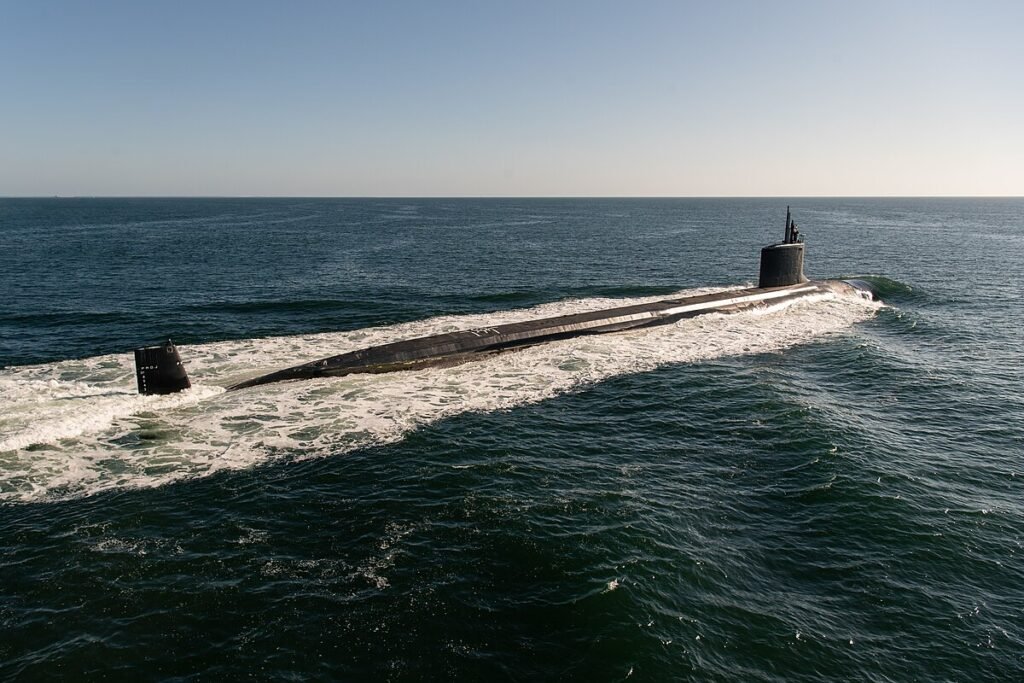
The U.S. Navy formally accepted delivery of the future USS Massachusetts (SSN 798), a Virginia class nuclear powered fast attack submarine, from Huntington Ingalls Industries (HII) Newport News Shipbuilding (NNS) division on November 21, 2025. This transfer marks the completion of the submarine’s construction phase by the shipbuilder and its official handover to the Navy, beginning the final tests and trials phase before its formal commissioning.
The status of SSN 798 in the production sequence involves two distinct figures reflecting the structure of the national nuclear shipbuilding strategy. The vessel is the 25th Virginia class submarine delivered overall since the program’s inception, a figure achieved through the long standing strategic co-production agreement between NNS and General Dynamics Electric Boat (GDEB) . Crucially, the vessel is also the 12th Virginia class submarine delivered specifically by the NNS shipyard . This dual designation highlights the effectiveness of the two yard teaming model, which relies on both facilities to construct and alternate the delivery of modular sections, thereby sharing the immense industrial workload necessary to produce these complex vessels .
Block IV Configuration: Emphasis on Operational Availability
Massachusetts is the seventh of ten submarines contracted under the Block IV production phase. While earlier blocks focused on design evolution and cost refinement, the Block IV design was strategically focused on maximizing the platform’s Operational Availability (O/A) throughout its service life. The primary engineering achievement involved incorporating design changes that reduce the total number of major scheduled maintenance periods (Depot Modernization Periods, or DMPs) from four to three over the submarine’s projected 33 year lifespan.
This reduction in maintenance cycles is projected to increase each Block IV submarine’s operational time, allowing for a minimum of 15 operational deployments over its service life, an increase of one full deployment compared to previous blocks. This optimization strategy aims to improve fleet readiness and presence without requiring an increase in the number of hulls constructed, aiding in the replacement of older Los Angeles class submarines.
The Massachusetts maintains the standard Block I IV dimensions, with a length of 377 feet and a submerged displacement of approximately 7,900 tons . The vessel is equipped for multi mission requirements, including anti submarine warfare (ASW), covert intelligence, surveillance, and reconnaissance (ISR), and the capacity to deploy Tomahawk cruise missiles . The submarine completed initial sea trials in October 2025, validating its core systems, including first submergence and high speed maneuvers. The formal commissioning is scheduled for the spring of 2026 .
Industrial Base Strain: Production Rate and Competing Demands
While SSN 798’s delivery is a technical success, it occurs during a critical period of quantitative strain on the Submarine Industrial Base (SIB). The U.S. Navy’s goal of maintaining a fleet of 66 attack submarines requires the SIB to sustain a production rate of 2.0 Virginia class SSNs per year . However, the current output remains constrained at approximately 1.2 SSNs per year. This persistent production deficit has led to a growing backlog, extending the lead time between funding and delivery to roughly nine years.
The constraint is primarily attributed to the concurrent priority placed on the Columbia class Ballistic Missile Submarine (SSBN) program. The Columbia class vessels are significantly larger, consuming specialized labor and critical materials that otherwise would be available for Virginia class construction. Furthermore, the SIB faces pressure from the AUKUS security agreement, which mandates the transfer of some Virginia class SSNs to Australia. To meet the domestic force goal while replacing these transferred vessels, the required long term production rate must ultimately reach 2.33 SSNs per year .
The Strategic Pivot to Block V: Lethality and the VPM
The near conclusion of the Block IV phase signals the transition to Block V, which the Navy views as a “generational leap” focusing on enhanced lethality. The defining feature of Block V is the integration of the Virginia Payload Module (VPM) .
The VPM is an 83 foot long mid body hull section added to the design, incorporating four additional large diameter payload tubes. Each tube is engineered to store and launch up to seven Tomahawk cruise missiles. This expansion boosts the vessel’s total missile capacity to over 40, positioning Block V submarines to absorb the large scale covert strike missions previously assigned to the retiring Ohio class guided missile submarines (SSGNs). The VPM also provides flexibility for future weapons and systems, including hypersonic missiles and large Unmanned Undersea Vehicles (UUVs) . The addition of the VPM increases the Block V length to 460 feet and submerged displacement to approximately 10,200 tons.
Conclusion: Assessment of Program Status
The delivery of the future USS Massachusetts confirms the qualitative success of the Block IV program, adding a highly reliable, high endurance asset to the fleet. This success validates the efficacy of the dual yard construction model. However, the challenge facing the U.S. Navy is predominantly quantitative. The maintenance of undersea superiority requires the SIB to rapidly scale its output to the necessary 2.0 SSN/year rate, and subsequently the 2.33 SSN/year rate, to mitigate the accumulating backlog and meet complex global strategic commitments .