The emergence of sixth-generation (6th-Gen) fighter aircraft represents a transformative evolution in military aviation, redefining operational philosophy, technological integration, and strategic postures. Unlike incremental upgrades of fifth-generation platforms, sixth-generation programs are designed as integrated systems of systems, where manned fighters operate as command nodes coordinating autonomous assets in a networked combat environment. This article examines the global 6th-Gen landscape, with a focus on programmatic strategies, technological breakthroughs, and comparative analysis against fifth-generation platforms. It also evaluates the strategic and geopolitical implications of industrial sovereignty, multinational collaboration, and emerging adversary capabilities, highlighting the decisive role of artificial intelligence, adaptive propulsion, and multi-domain integration in future air dominance.
1. Introduction
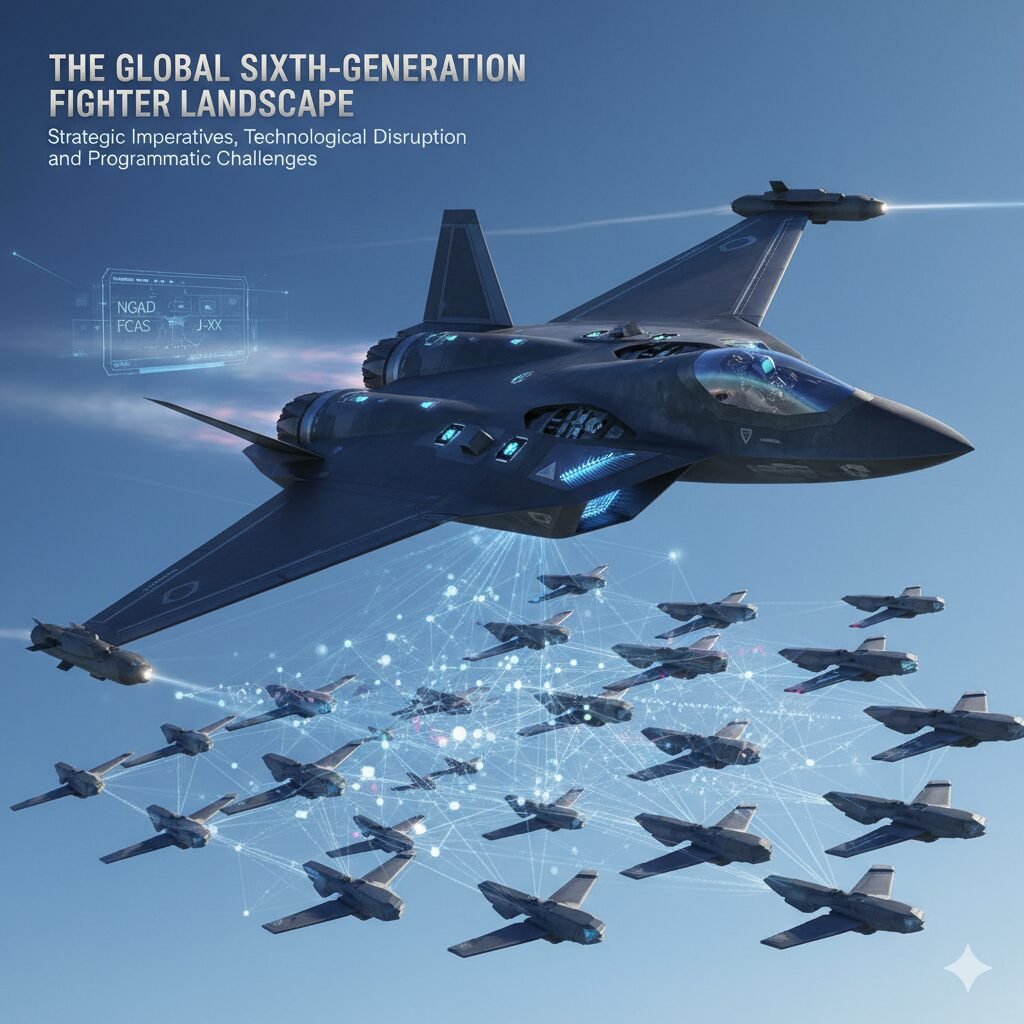
Military aviation has undergone several generational shifts, each defined by technological innovation and operational doctrine. Fifth-generation aircraft, epitomized by platforms such as the F-22 Raptor and F-35 Lightning II, emphasized stealth, high kinetic performance, and internal weapons carriage. The sixth-generation fighter represents a departure from platform-centric design towards network-centric combat capability, integrating advanced propulsion, artificial intelligence, and multi-domain systems. Manned fighters are increasingly envisioned as command nodes in a larger system, orchestrating autonomous Collaborative Combat Aircraft (CCA) and Remote Carriers (RC) to achieve distributed lethality.
Global efforts in 6th-Gen development cluster into three strategic poles. The United States, through the Next Generation Air Dominance (NGAD) initiative, aims to maintain air superiority with the Boeing F-47 and accompanying autonomous platforms. Europe is divided between the Future Combat Air System (FCAS) led by France, Germany, and Spain, and the Global Combat Air Programme (GCAP), a tri-national collaboration between the United Kingdom, Italy, and Japan. China and, to a lesser extent, Russia are advancing parallel programs, increasing the pace and complexity of Western development efforts.
2. Defining the Sixth Generation: Technological Paradigms
The sixth-generation fighter is characterized by its emphasis on networked superiority rather than platform-centric dominance. This shift is operationalized through manned-unmanned teaming (MUM-T), multi-domain integration, and the use of artificial intelligence to manage data flows and decision-making in high-density, contested environments.
2.1 Manned-Unmanned Teaming
MUM-T enables distributed lethality by pairing high-value manned platforms with fleets of autonomous drones. The United States aims to deploy over one thousand CCAs alongside F-47 and F-35 aircraft at a two-to-one ratio, allowing attritable drones to execute high-risk missions including reconnaissance, electronic warfare, and precision strikes. European programs mirror this approach, with FCAS employing Remote Carriers and GCAP deploying Loyal Wingmen concepts. The success of the 6th-Gen strategy hinges on controlling costs and scaling production for autonomous platforms to achieve the concept of affordable mass.
2.2 Digital Engineering and Open Architecture
Digital engineering, or model-based design, accelerates development by enabling rapid prototyping, testing, and integration of complex systems. Open-architecture avionics ensure future adaptability, allowing software-defined upgrades and integration of emerging technologies throughout the platform’s service life. This design philosophy reduces the risk of obsolescence and supports multi-domain operational integration.
2.3 Propulsion Advancements
Variable Cycle Engines (VCE) under programs such as Next Generation Adaptive Propulsion (NGAP) provide both fuel-efficient cruise and high-thrust supercruise, enabling operational ranges exceeding one thousand nautical miles. Beyond performance, VCEs supply electrical power to high-energy directed-energy weapons and advanced electronic warfare suites. Operational flexibility and thermal management are essential to sustain these energy-intensive systems, particularly in contested Anti-Access/Area Denial (A2/AD) environments.
2.4 Cognitive Warfare and the Combat Cloud
Artificial intelligence operates as a cognitive assistant, parsing sensor data and guiding operational decision-making at speeds exceeding human capabilities. The Combat Cloud connects manned fighters, remote carriers, and other air, ground, and space assets, providing a real-time, integrated information network that enhances situational awareness, command control, and multi-domain coordination.
2.5 Sensor Fusion and Signature Management
Multi-Function Apertures (MFA) consolidate radar, infrared, and electro-optical sensors, enabling true sensor fusion and dynamic reconfiguration during missions. These systems reduce size, weight, and power requirements while improving reliability and survivability in multi-spectral threat environments. Coupled with high-energy directed-energy weapons, MFAs allow sixth-generation fighters to operate effectively against dense sensor networks and emerging kinetic and non-kinetic threats.
3. Comparative Analysis: Fifth vs Sixth Generation
The technological and operational distinctions between fifth and sixth-generation fighters are profound. Fifth-generation platforms such as the F-35 prioritize stealth, internal weapons carriage, fixed-cycle propulsion, and moderate combat radius, relying on discrete sensors and limited networking capabilities such as Link 16 or MADL.
In contrast, sixth-generation aircraft such as the F-47 and Tempest employ Variable Cycle Engines, providing both efficiency and high-thrust performance while supplying power for directed-energy and electronic warfare systems. Networking evolves into a software-defined, high-capacity Combat Cloud integrating all-domain sensors and autonomous assets. Multi-Function Apertures allow consolidated sensor fusion, while AI-driven autonomy supports both pilot cognition and drone swarm management. Weapon systems now include both kinetic and high-energy directed-energy weapons. Operational ranges exceed one thousand nautical miles, enabling engagement from dispersed basing in A2/AD environments.
4. Major Western-Aligned Programs
The major Western-aligned sixth-generation fighter programs reflect diverse strategic approaches and industrial models. In the United States, the NGAD program focuses on the F-47 Penetrating Counter-Air platform, which is scheduled to make its first flight around 2028, with a planned fleet of at least one hundred eighty-five aircraft. These manned fighters will be complemented by Collaborative Combat Aircraft, integrating AI-driven autonomy to enable distributed operations and maximize operational reach.
In Europe and Japan, the Global Combat Air Programme unites the United Kingdom, Italy, and Japan’s respective development efforts to produce the Tempest aircraft. This platform will feature optionally manned operations, onboard supercomputing capabilities, and high-energy weaponry, with service entry anticipated around 2035.
Meanwhile, the Future Combat Air System, led by France, Germany, and Spain, is centered on the New Generation Fighter, designed to operate alongside Remote Carriers and a networked Combat Cloud. The program targets operational capability around 2040, but industrial tensions—particularly France’s Dassault seeking predominant control over the NGF component—pose risks to both schedule and cost.
The U.S. Navy is pursuing a parallel initiative with the F A-XX program, tailored for carrier-based operations and optimized for the unique propulsion and structural requirements of maritime aviation. The F A-XX is expected to follow a fielding timeframe similar to that of the F-47, providing the Navy with a complementary sixth-generation capability.
5. Adversary and Emerging Programs
China’s classified programs, tentatively referred to as J-XX or J-50, are reportedly three to four years ahead of Western platforms. Dual prototype strategies by Chengdu and Shenyang accelerate technological iteration and risk mitigation. Russia’s programs, including the Sukhoi Su-75 Checkmate and MiG-41, face financial and sanctions-induced constraints. Other nations, including South Korea and Sweden, are laying industrial groundwork for future sixth-generation capabilities.
6. Strategic Implications and Industrial Considerations
The development of sixth-generation fighters illustrates the tension between industrial sovereignty and collaborative efficiency. European programs reflect divergent approaches, with FCAS demonstrating challenges of centralized control, while GCAP presents a balanced model conducive to political and programmatic stability. Programmatic risk arises from integration of unproven technologies, complex manufacturing, and budget constraints. Chinese advancements amplify the urgency of meeting development timelines. Maturation of autonomous systems may, in the long term, reduce the need for large fleets of bespoke manned aircraft.
7. Conclusions
Sixth-generation fighters redefine air dominance through networked integration, AI-driven autonomy, adaptive propulsion, and multi-domain systems. Success is dependent on mastery of digital architectures, algorithmic processing speed, and power management for high-energy systems. The crewed fighter serves as a flying command center, orchestrating autonomous assets in distributed operations, with strategic outcomes determined more by software and data integration than traditional aerodynamic performance. Air superiority in the 2030s will therefore depend on system-of-systems integration, cognitive speed, and the ability to leverage multi-domain operational capabilities effectively.