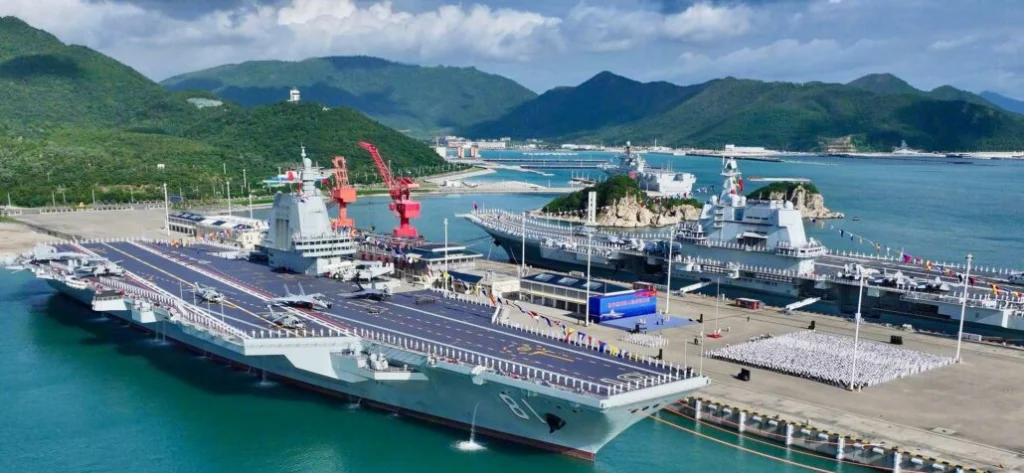
China commissioned its newest aircraft carrier, Fujian (Hull No. 18), at a ceremony held at the Yulin/Longpo Naval Base in Hainan on 5 November 2025, with President Xi Jinping in attendance. The event marked the end of a multi-year construction and trials process that began in the mid-2010s. Built by Jiangnan Shipyard and launched on 17 June 2022, the carrier entered service after completing nine sea trials and a wide range of system and aviation tests. Fujian is China’s third aircraft carrier and the first of the Type 003 class. It is also the country’s first indigenously designed carrier capable of catapult-assisted aircraft operations, representing a shift from the ski-jump STOBAR configuration used on Liaoning and Shandong.
The ship incorporates electromagnetic catapult systems rather than steam pistons, making China the second country after the United States to operate an aircraft carrier equipped with EMALS technology. Fujian’s EMALS is powered by a medium-voltage direct-current integrated power system, which Chinese sources describe as the first MVDC configuration used on an aircraft carrier. This system supports the launch of both heavier and lighter aircraft and reduces the stress typically placed on airframes during takeoff. The choice of electromagnetic catapults required substantial testing; prototypes appeared as early as 2012, and engineering adjustments continued during the ship’s construction phase. Delays linked to both electromagnetic and steam catapult tests in 2017 indicate the technical complexity of integrating such a system into a conventionally powered hull.
Fujian measures roughly 316 meters in length, with an estimated displacement between 80,000 and 85,000 tons. Its flight deck includes three electromagnetic catapults, an angled landing area with arresting gear, and two starboard elevators. These features allow the carrier to accommodate an air wing projected to include more than forty fixed-wing aircraft and around a dozen helicopters. Aircraft expected to operate from the deck include the J-15T multirole fighter, the J-15DT electronic-warfare variant, the J-35 stealth fighter, the KJ-600 early warning aircraft, and the HZ-20 utility helicopter. State media later confirmed that Fujian became the first Chinese carrier to launch a fifth-generation fighter using an electromagnetic catapult—an achievement previously demonstrated only by the U.S. Navy.
Sea trials began in May 2024, with the first trial lasting from 1 to 8 May. Subsequent trials grew longer and more complex, including possible aircraft movements, as suggested by tire markings on the deck upon its return from the fifth trial in December 2024. Trials continued into 2025, including seventh and eighth deployments that focused heavily on aviation integration. By late May 2025, the ship was conducting tests involving J-35 aircraft adapted for catapult operations. On 1 August 2025, Chinese media released footage hinting at electromagnetic launches of the J-15T, although sequences were incomplete. Analysts at the time interpreted this as a sign that Fujian’s aviation systems were approaching a critical stage of verification.
The ninth trial began on 10 September 2025 and drew regional attention when Japanese authorities confirmed the carrier’s presence northwest of the Senkaku Islands. The carrier later transited the Taiwan Strait before heading toward the South China Sea for further testing. Chinese officials described the voyage as a routine component of the ship’s cross-regional trial program. On 22 September, state broadcasters released complete launch and recovery footage showing the J-15T, J-35, and KJ-600 operating with EMALS and arresting gear. PLAN announced that Fujian had achieved what it called “initial full-deck operational capability,” indicating that the basic integration of the air wing and deck systems had reached a functional stage.
Plans for Fujian’s commissioning circulated widely in the weeks leading up to November, with speculation based on historical patterns from previous carriers. The official ceremony on 5 November confirmed the end of the testing phase and the beginning of its operational integration into the fleet. Observers view Fujian as part of a gradual but consistent expansion of China’s carrier program, which began with the acquisition of Liaoning and continued through the domestic construction of Shandong. Fujian’s entry into service adds a larger platform with a different launch system, but its long-term role will depend on how PLAN develops training cycles, sortie generation practices, and integration with future carrier battle group components.